
What Is a Free Spins Bonus Round? A Simple Slot Guide

A slot can suddenly feel like a completely different game when several scatter symbols appear. The background changes, new music starts, and a message announces that you have unlocked a set of spins without paying for each round separately.

This feature is known as a Free Spins Bonus Round. It is built into many online slots and normally becomes available after a specific symbol combination or collection requirement is completed.

Although the feature may include extra wilds, multipliers, or expanded reels, it does not guarantee a profitable result.

The number of spins, payout rules, and special mechanics are controlled by the game’s mathematical design. Understanding those rules makes the bonus much easier to follow.

What Is a Free Spins Feature?

A free spins feature is a sequence of bonus rounds played without an additional wager being deducted for every spin. The original triggering bet is usually used to calculate any prizes.

For example, a bonus activated with a $0.50 stake will normally continue at that value. The player cannot usually increase the bet after entering the feature.

The bonus may use the regular reel grid or switch to a different layout with additional symbols and mechanics.

How Is the Bonus Triggered?

Scatter symbols are the most common triggers. A game might require three scatters anywhere on the reels to award eight spins, while four or five scatters provide a larger number.

Other slots use collection meters, mystery events, bonus wheels, or special combinations. The requirements should be explained in the game’s paytable or help menu.

UK Gambling Commission standards state that applicable rules-including how players qualify for a feature and how the feature behaves-should be available before they gamble.

What Happens During the Feature?

Once the bonus starts, the game displays the number of spins available. Each round then runs according to the feature’s special rules.

A slot may add sticky wilds, expanding symbols, multipliers, cascading reels, or a larger grid. These mechanics can create additional winning possibilities, but their presence does not promise a prize.

The remaining number of rounds should usually be visible so players can understand the current state of the feature.

How Do Retriggers Work?

A retrigger awards additional spins after the bonus has already started. It commonly occurs when another set of scatter symbols appears during the feature.

Imagine beginning with ten spins. During the fourth round, three scatters award five more. After that round finishes, eleven spins would remain.

Some games allow several retriggers, while others place a limit on the total number available. The exact maximum should appear in the rules.

How Are Bonus Payouts Calculated?

Payouts are based on the paytable, qualifying symbols, active multipliers, and triggering stake.

Suppose a winning combination is worth 12 times the original $0.50 wager:

12 × $0.50 = $6

If the bonus also applies a 3× multiplier, the prize may become $18. However, multipliers can apply differently between games, so players should check whether they affect individual symbol wins, the total bonus, or only selected reels.

Are the Outcomes Still Random?

Yes. Digital slots generally use a Random Number Generator to produce unpredictable outcomes. Testing laboratories examine RNG systems to check for bias and predictability.

The bonus does not remember whether the previous feature paid well or poorly. A disappointing round does not make the next one more likely to deliver a large prize.

Each result follows the probabilities built into the game.

Are Bonus Spins Included in RTP?

The mathematical contribution of the feature is generally included in the slot’s theoretical Return to Player percentage. Test laboratories can analyse the base game, feature game, and jackpot components when calculating RTP.

This means part of the advertised return may come from relatively uncommon bonus events. A short session that never reaches the feature can finish far below the theoretical average.

RTP is measured over extensive play, not one bonus or one player’s session.

A Free Spins Bonus Round is a built-in slot feature that awards several rounds without taking a separate stake for every spin. It is commonly triggered by scatters and may introduce wilds, multipliers, retriggers, or expanded reels.

The feature can be entertaining, but it does not guarantee a profit or make future outcomes predictable. Before playing, open the paytable and check the trigger requirements, number of spins, multiplier rules, and payout calculations.

Use demo mode to explore unfamiliar mechanics, set an affordable limit, and never continue playing simply because a bonus appears overdue.

Does a Higher RTP Mean You Will Win More? The Real Answer

A slot with a 97% Return to Player percentage may look much more attractive than one offering 94%. At first glance, it seems logical to assume that the higher number means more wins, longer sessions, and a better chance of leaving with a profit.

But does a higher RTP mean you will win more? Not necessarily. A higher percentage generally indicates a smaller long-term mathematical advantage for the operator. It does not guarantee more winning spins, larger prizes, or a profitable individual session.

To understand the difference, you need to know what RTP measures, how long-term averages work, and why random variation can dominate short-term results.

What Does RTP Actually Measure?

RTP stands for Return to Player. It represents the theoretical percentage of total wagers that a game is designed to return as prizes over a very large number of rounds.

For example, a slot with 96% RTP is designed to return approximately $96 from every $100 wagered collectively over the long term. The remaining $4 represents the game’s theoretical house advantage.

However, the UK Gambling Commission explains that RTP is an average measured across many games. Random machines may require more than 100,000 rounds before their results begin approaching the designed percentage.

Higher RTP Means a Lower House Edge

The relationship between RTP and the house edge can be calculated easily:

House Edge = 100% − RTP

A 97% slot has a theoretical house edge of 3%, while a 94% game has an edge of 6%. Over substantial turnover, the 97% game is designed to retain a smaller share of the money wagered.

Suppose each game processes $100,000 in stakes. In theory, the 97% game would return $97,000, while the 94% version would return $94,000. These are long-term mathematical expectations, not guaranteed results for one player.

Higher RTP Does Not Mean More Winning Spins

RTP measures the total value of prizes, not how frequently payouts occur. A slot can have a high theoretical return while producing relatively few winning combinations.

Another game may create winning animations more frequently but award prizes that are often smaller than the original stake. Betting $1 and receiving $0.40 is technically a payout, but the net result is still a $0.60 loss.

This is why RTP should not be confused with hit frequency. The two measurements describe different parts of the game.

Short Sessions Can Produce Any Result

A player completing 50 spins represents an extremely small sample compared with the hundreds of thousands or millions of rounds used in mathematical testing.

During those 50 spins, a 97% slot might produce a large bonus, several small payouts, or no meaningful return. A 94% game could temporarily produce a better result.

Theoretical and actual RTP can differ considerably when the sample is small. As more gameplay is recorded, actual performance should gradually move closer to the designed percentage.

Every Spin Remains Random

Digital slots generally use a Random Number Generator to determine individual outcomes. Testing laboratories evaluate these systems to check that results are unpredictable and do not favour particular outcomes unfairly.

A high-RTP slot does not adjust the next spin because a player has recently lost. Previous results do not make a payout “due.”

Similarly, a large win does not automatically make the next round less likely to pay. The percentage emerges through the complete mathematical model over extensive play.

How Should Players Use RTP?

RTP is most helpful as a comparison tool. When two games have similar volatility, rules, and bonus structures, the one with the higher percentage generally has the smaller long-term mathematical disadvantage.

However, the difference between 96% and 97% may be almost invisible during a short session. Stake size, volatility, and random outcomes can have a much greater immediate effect.

Check the percentage in the official game rules, calculate the total cost per spin, and decide on a firm spending limit before playing.

A higher RTP can provide a better theoretical return over a very large number of wagers, but it does not guarantee more winning spins or a profitable session.

The percentage describes long-term game mathematics rather than what will happen during your next 20, 50, or 100 rounds. Use RTP to compare the operator’s theoretical advantage, but also consider volatility, payout frequency, bonus contributions, and stake size.

Never continue simply because a high-percentage game appears likely to recover earlier losses. Read the official rules, set affordable limits, and treat every wager as entertainment money that could be lost.

How to Find the RTP of an Online Slot in a Few Simple Steps

Return to Player is one of the most useful numbers you can check before opening an online slot. Usually shortened to RTP, it describes the theoretical percentage of total wagers that a game is designed to return as prizes over a very large number of rounds.

The problem is that this figure is not always placed prominently on the main screen. It may be hidden inside a paytable, help page, information menu, or lengthy set of game rules.

Learning how to find the RTP of an online slot only takes a few minutes. The steps below will help you locate the official percentage, understand what it represents, and avoid confusing theoretical RTP with personal session results.

Open the Information or Help Menu

Start the game without placing a real-money wager. Look around the screen for an information button, question mark, menu icon, or letter “i.”

Opening this section should reveal the game rules, symbol values, bonus instructions, and betting information. The RTP may appear near the beginning of the document or inside a section titled “Game Information,” “Payout,” or “Theoretical Return.”

In British-regulated remote gambling, information about the likelihood of winning must be easily available before a customer commits to gambling. This may be shown as RTP, house edge, or the probability of specific outcomes.

Check the Slot Paytable

The paytable explains which symbols produce prizes and how payouts are calculated. Many developers also place the theoretical return near the bottom of this section.

Scroll through every page rather than stopping after the symbol values. The RTP may be listed beside volatility, maximum win, game version, or software identification details.

For example, you might see a statement such as “The theoretical RTP of this game is 96.20%.” That is the figure built into the selected version-not a guaranteed return for your session.

Read the Full Game Rules

Some slots separate the visual paytable from their legal or technical rules. Look for links labelled “Rules,” “About,” “More Information,” or “Terms.”

Use the browser’s page-search function when the document is long. Search for terms such as:

RTP, Return to Player, Theoretical Return, Payout Percentage, or House Edge

Regulatory guidance identifies theoretical RTP as the designed percentage displayed in the player-facing rules. Actual RTP, by contrast, is calculated from real turnover and prizes during a specific period.

Check the Game Provider’s Website

When the percentage is missing from the casino interface, search for the slot on the developer’s official website. Product pages, fact sheets, game certificates, or downloadable rule documents may state the default RTP.

Confirm that the title, release, jurisdiction, and software version match the game you are viewing. A provider’s promotional page may describe a default configuration that is not used by every operator.

The game loaded inside the casino should therefore remain your primary source. Treat the provider’s page as supporting information rather than automatic confirmation.

Make Sure You Have the Correct Version

Some slots can be offered in several RTP configurations. The design, symbols, and bonus rounds may look identical even when the underlying percentages differ.

For example, one operator might host a 96% configuration while another offers a 94% version. A review written about the first version would not accurately describe the second.

Look for a version number or mathematical model identifier in the rules. Games supplied in regulated markets are independently tested to verify that the advertised percentage is accurate and that the software follows its published rules.

Understand What the Percentage Means

Suppose the official rules state an RTP of 96%. This means the game is designed to return approximately $96 in prizes for every $100 wagered collectively over extensive play.

It does not mean that depositing or wagering $100 guarantees a $96 balance. Random slot results can vary significantly, especially over a short session.

Theoretical returns are evaluated using very large samples and simulations. Testing organisations analyse whether pay combinations move toward their expected probabilities over time.

Avoid Unofficial “Live RTP” Claims

Some websites advertise live percentages that supposedly reveal which slots are ready to pay. These figures should not be confused with the official theoretical return shown in the rules.

Previous payouts cannot reliably predict the next random outcome. A slot performing below its long-term average is not required to compensate a particular player on the next spin.

Use the percentage to understand the game’s mathematical structure, not to time bets or chase a supposedly overdue payout.

The easiest way to find the RTP of an online slot is to open the information menu, inspect the complete paytable, and read the official game rules.

When the number is still missing, check the developer’s website and confirm that its game version matches the one offered by the operator. Never rely entirely on reviews, promotional pages, or so-called live payout trackers.

The official percentage is theoretical and applies across extensive play, not one individual session. Check it before wagering, compare it with the game’s volatility and rules, and always set an affordable spending limit before pressing spin.

What Is a Slot Machine? A Beginner-Friendly Explanation

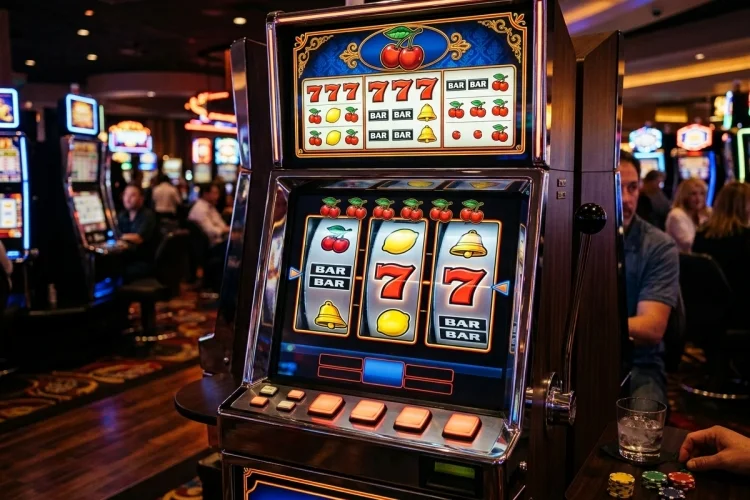
A slot machine is one of the easiest casino games to recognise. It usually has spinning reels, colourful symbols, a button or lever, and a paytable showing the available prizes.

Despite its simple appearance, plenty of technology and mathematics operate behind every spin. So, what is a slot machine, and how does it actually work?

In basic terms, it is a gambling game in which a player places a bet and receives a randomly determined combination of symbols. A prize is awarded when those symbols match one of the winning patterns listed in the game rules.

Modern versions may use physical reels, video screens, websites, or mobile apps, but they all follow this basic concept.

The Basic Purpose of a Slot Machine

A slot machine accepts a stake and produces a game result. Depending on the outcome, the player may receive no prize, a small return, a bonus feature, or a larger jackpot.

Unlike games such as poker or blackjack, standard slot results do not normally depend on a player’s strategic decisions. The main choices involve selecting the game, setting the stake, and deciding when to stop.

Gaming machines are also commonly called fruit machines, jackpot machines, or slots, although the exact terminology varies between countries.

Reels, Rows, and Symbols

Reels are the vertical columns containing symbols. Traditional machines generally use three physical reels, while video slots commonly display five or more virtual columns.

Rows run horizontally across the screen. A five-reel game with three rows displays 15 visible symbol positions.

Symbols can include numbers, fruit, playing-card icons, characters, or themed objects. Special symbols such as wilds, scatters, and bonus icons may substitute for other symbols or activate additional features.

How Paylines Create Winning Combinations

A payline is a pattern connecting symbol positions across the reels. It may run horizontally, diagonally, or in a zigzag shape.

For example, a game may require three matching symbols to appear from left to right on an active line. Matching symbols outside that pattern might not produce a prize.

Not every modern game uses traditional lines. Some offer hundreds of adjacent-reel combinations, while others pay for clusters of connected symbols. The game rules should clearly explain how wins are formed before a player places a wager.

What Happens When You Press Spin?

After the player selects a stake and presses spin, the game begins a new round. The system determines an outcome, displays the corresponding symbols, checks them against the paytable, and updates the balance.

On a mechanical machine, motors rotate and stop physical reels. Electronic machines can use a central processor to determine the result and direct reel motors to stop at the required positions.

In an online slot, the spinning reels are visual representations created by software. The animation displays the chosen result rather than physically generating it.

The Role of the Random Number Generator

Modern digital slots generally use a Random Number Generator, or RNG. This system continually generates numerical values that can be mapped to reel positions and game outcomes.

Regulatory standards require RNG-driven results to be statistically unpredictable. They also prohibit adaptive behaviour that changes outcomes simply to compensate for earlier wins or losses.

Each spin should therefore be treated as a separate event. A long losing sequence does not mean the next round must produce a prize.

How Payouts Are Calculated

The paytable lists each symbol’s value and the combinations needed to win. A payout may be shown as credits, a fixed amount, or a multiplier of the relevant stake.

Suppose three matching symbols award 15 times a $0.40 bet. The prize would be:

15 × $0.40 = $6

Always check whether the multiplier applies to the total stake, line bet, or coin value. These figures can produce very different results.

Understanding RTP and Volatility

Return to Player, usually shortened to RTP, is a theoretical percentage representing how much of the total money wagered may be returned as prizes over many rounds.

A 96% RTP does not promise that someone spending $100 will receive $96. The percentage is a long-term average, and an individual session may finish far above or below it.

Volatility describes how prizes may be distributed. Lower-volatility games generally offer smaller, more frequent returns, while higher-volatility games can produce longer gaps between prizes.

A slot machine is a chance-based game built around wagers, reels, symbols, and predefined payouts. Physical and digital versions may look different, but both generate a result and compare it with a paytable.

Modern slots commonly use RNG software to make each round unpredictable. Understanding reels, paylines, RTP, and volatility will not predict the next winning combination.

It simply helps players understand the rules and costs more clearly. Before playing, check local laws, read the paytable, confirm the total stake, and establish strict time and spending limits. Treat every slot as paid entertainment rather than a reliable source of income.

How to Play Online Slots: A First-Time Player’s Guide

Playing an online slot for the first time can feel slightly confusing. The screen may contain reels, paylines, multipliers, bonus symbols, betting controls, and several buttons that are not immediately obvious.

Fortunately, learning how to play online slots does not require advanced technical knowledge. The basic process involves choosing a game, selecting a stake, pressing the spin button, and checking whether the symbols create a winning combination.

However, understanding the controls is only part of the preparation. New players should also know how paytables, Random Number Generators, Return to Player percentages, and spending limits work.

This beginner’s guide explains the process step by step while keeping the risks and practical realities clear.

Check That Online Gambling Is Legal

Before creating an account, confirm that online gambling is permitted in your location and that you meet the minimum legal age. Laws, licensing requirements, and consumer protections vary between countries and regions.

Choose only a platform licensed by a recognised regulator in the jurisdiction where you live. A licensed operator should provide information about its licence, game rules, customer support, privacy policy, and safer-gambling tools.

Avoid websites that hide their ownership or licensing details. A large welcome bonus does not make an unregulated platform trustworthy.

Start With a Demo Game

Demo mode lets you explore a slot using virtual credits rather than real money. It is a useful way to learn where the spin, bet, information, and settings buttons are located.

Use the practice version to see how quickly credits can rise or fall. Test different stake settings and open the game’s help section before considering real-money play.

Demo results should not be treated as evidence that the same pattern will continue with money. Each spin remains random, and a winning practice session does not predict future outcomes.

Read the Paytable Before Spinning

The paytable explains how the slot works. It shows symbol values, winning patterns, bonus triggers, jackpot rules, and any special features.

Some slots pay when identical symbols appear on traditional paylines. Others use clusters, adjacent reels, or hundreds of “ways to win.” Never assume that two games follow identical rules.

Regulated games may be required to display rules and prize information before a player commits money. Reading these details prevents confusion about why a particular symbol combination did or did not pay.

Choose a Small Total Stake

Slots may display stakes as coin values, line bets, betting levels, or one total amount. Check the final cost of a spin rather than focusing only on the smallest number shown.

For example, a game might display a coin value of $0.01 but apply it across multiple lines and levels. The actual total could therefore be much higher than one cent.

Start with the lowest practical setting while learning the interface. Increasing a bet does not make a winning result due or improve the predictability of the reels.

Press Spin and Understand the Result

After selecting the stake, press the spin button once. The game’s Random Number Generator chooses an outcome, and the reels animate to display the corresponding symbols.

Testing laboratories examine RNG systems to determine whether they produce unpredictable and statistically appropriate results. In regulated markets, games and RNGs may need testing before release.

Previous spins do not control the next one. Ten losses in a row do not guarantee that the following round will win.

Understand Wins and Net Results

When a combination wins, the game normally highlights the symbols and displays a prize. That prize is added to the account balance after the round.

A displayed win does not necessarily mean the player made a profit. If a $1 spin returns $0.40, the animation may celebrate a payout, but the net result is still a $0.60 loss.

Watch the balance rather than relying on sounds or visual effects. This provides a more accurate picture of the session.

Set Limits Before Using Real Money

Decide how much money and time you are prepared to spend before beginning. The amount should be affordable entertainment money, not cash needed for food, bills, rent, debt payments, or savings.

Deposit limits, time reminders, breaks, and self-exclusion tools can help players control their activity. GamCare specifically recommends limit setting, frequent breaks, and self-exclusion among its safer-gambling measures.

Never increase the stake simply to recover a loss. Chasing losses can turn a planned entertainment session into uncontrolled spending.

Learning how to play online slots begins with understanding the interface, not finding a secret winning method. Check local laws, use a licensed platform, practise in demo mode, and read the paytable carefully.

Once you understand the rules, select a small total stake and remember that every spin is unpredictable. Most importantly, establish firm money and time limits before playing.

Online slots should be treated as paid entertainment rather than a source of income. Start with free-play mode, examine the game information, and only consider real-money play when it is legal, affordable, and completely optional.