

Skip to content

Recent Posts

  • Mythology Slots and the Lasting Power of Ancient Game Worlds
  • Norse Mythology Slots: Gods, Runes, and Bonus Rounds Explained
  • Compare Slots Better: Volatility, Hit Rate and Payout Distribution
  • Classic Fruit Slots: Why Simple Reels Still Feel Fresh
  • NetEnt Slots: From Classic Hits to Modern Features

Most Used Categories

  • Free Slots (5)
  • Slot Themes (4)
  • Megaways Slots (4)
  • Slot Guides (3)
  • Mobile Slots (3)
  • Slot Features (3)
  • Slot Providers (2)
  • Jackpot Slots (2)
  • High-RTP Slots (2)
  • Slot Reviews (2)
Skip to content
Synergie Solutions Web

Synergie Solutions Web

Subscribe
  • Jackpot Slots
  • Megaways Slots
  • Mobile Slots
  • Slot Features
  • Slot Providers
  • Slot Guides

Home › Slot Guides

Category: Slot Guides

Compare Slots Better: Volatility, Hit Rate and Payout Distribution

Compare Slots Better: Volatility, Hit Rate and Payout Distribution

Elena Morales08/25/202608/13/2026

Imagine two online slots showing almost the same RTP. Both have colourful bonus rounds, wild symbols, and maximum prizes reaching thousands of times the stake. On paper, they might look almost interchangeable.

Play them across a very large mathematical sample, however, and their payout patterns could be completely different.

To Compare Slots intelligently, you need to understand how frequently prizes appear and how widely their values are distributed. Hit rate provides information about winning-event frequency, while volatility describes variation around the expected result.

Payout distribution adds another dimension by showing whether theoretical return is concentrated in frequent small prizes, occasional medium wins, or rare high-value events.

Put those metrics together and a slot’s mathematical personality becomes much easier to understand.

Why RTP Alone Creates an Incomplete Comparison

RTP attracts attention because it gives players a simple percentage.

A 96.5% game looks slightly higher than one offering 95.5%.

But that percentage does not tell you how either game distributes its prizes.

The UK Gambling Commission defines theoretical RTP as the designed return percentage, while actual RTP comes from the relationship between recorded wins and turnover.

The theoretical figure emerges over a very large number of game rounds.

It does not promise a particular return over 50, 100, or 1,000 spins.

The Commission explains that random games may sit considerably above or below target RTP over relatively small samples, with the averaging effect becoming more meaningful only after many games.

So RTP is useful—but it answers a long-term average question rather than describing session smoothness.

Volatility Explains the Size of the Swings

Volatility helps fill that gap.

The Gambling Commission describes standard deviation as the most common mathematical representation of volatility. A high-volatility game can include comparatively large but rare prizes, while lower-volatility models are generally more predictable and dominated by smaller, more frequent awards.

Imagine three payout profiles.

A low-volatility model might frequently produce outcomes around 0.5×, 1×, 2×, and 5× stake.

A medium-volatility model could spread more probability toward 10×, 25×, and occasional 100× results.

A high-volatility game might contain more losing rounds while reserving part of its theoretical return for rare prizes worth hundreds or thousands of times the stake.

These examples are illustrative, but they show what volatility really means: dispersion.

The wider the distribution, the less an ordinary short sample represents the mathematical average.

Hit Rate Measures Frequency, Not Quality

Hit rate sounds more intuitive than volatility.

If Game A has a higher hit frequency than Game B, Game A generates defined winning outcomes more often according to its mathematical model.

But this can still be misleading.

Imagine a $1 stake producing a $0.20 payout.

It is technically a winning combination under many game structures, even though the result represents a net loss relative to the stake.

A game could therefore have a high hit rate largely because it awards many small returns.

Another could show a lower rate but larger average wins.

When attempting a comparision, you should always ask:

What counts as a hit?

What is the average value of that hit?

How much of the RTP comes from rare bonus events?

Without those questions, hit frequency becomes just another isolated percentage.

Payout Distribution Connects the Other Metrics

Payout distribution is arguably the most useful concept because it connects RTP, volatility, and hit frequency.

Consider two theoretical 96% RTP games.

Game A’s expected return might be distributed like this:

Most payable events occur in the base game, free spins trigger relatively frequently, and the biggest outcomes remain moderate.

Game B might place a greater share of return into rare bonus rounds containing powerful multipliers.

The average theoretical return can still equal 96%.

What changes is where the money sits inside the probability model.

A real-world example of this trade-off appears in Pragmatic Play’s Zeus vs Hades – Gods of War. Its Olympus mode offers a higher probability of triggering the bonus but a lower average bonus win, while Hades offers rarer bonus triggers with higher average wins.

That is a near-perfect illustration of how frequency and payout size can be balanced against each other.

Bonus Frequency Can Hide Volatility

A frequently triggered bonus does not automatically mean a low-volatility game.

What happens inside the feature matters too.

Suppose Game A triggers free spins every 80 rounds on average and those features usually return around 10×–30× stake.

Game B triggers every 50 rounds but most features pay very little, while a tiny proportion can reach several thousand times the stake.

Despite its more frequent bonus, Game B could still have substantial variance because its feature results are widely dispersed.

Similarly, maximum-win potential should not be mistaken for average bonus value.

A 10,000× maximum only describes the extreme upper boundary.

It gives no information about whether the typical feature pays 5×, 50×, or 500×.

That missing probability information is why provider volatility ratings and detailed game rules remain useful alongside headline specifications.

Compare Similar RTP Games Side by Side

One practical method is to begin with games offering similar theoretical RTP and then compare their remaining characteristics.

Imagine:

MetricSlot ASlot BSlot C
RTP96.1%96.2%96.0%
Hit Rate34%26%18%
VolatilityLow/MediumMediumHigh
Max Win1,500×5,000×20,000×
Bonus FrequencyHigherModerateLower

This table does not reveal every part of the game math, but it immediately provides more information than RTP alone.

Slot A may distribute value more regularly.

Slot B looks more balanced between frequency and prize size.

Slot C appears to concentrate more potential in rarer high-value events.

Notice the wording: may, looks, and appears.

Without the complete probability model, these characteristics should not be treated as guarantees about future results.

They describe design tendencies.

Higher Volatility Needs Larger Samples to Evaluate

Volatility also changes how much data is needed before performance becomes statistically useful.

The UK Gambling Commission provides an example showing that the acceptable deviation around theoretical RTP shrinks as more game rounds are observed. At 50,000 rounds, the example has a much wider acceptable tolerance than at one million rounds.

Its testing guidance similarly notes that simulation testing uses a high number of automated rounds, with the amount depending partly on game volatility.

This explains why statements such as “I played this slot 200 times and its RTP seems bad” are mathematically weak.

Two hundred rounds are a tiny sample, particularly for a high-variance product.

A rare feature or large prize appearing once—or not appearing at all—can dramatically distort the observed percentage.

Short personal sessions are experiences, not reliable RTP tests.

That is an important differnce.

Read Provider Descriptions Carefully

Official game pages can sometimes reveal useful clues about payout structure.

Pragmatic Play describes Greedy Wolf as medium volatility with a maximum payout of 3,000×. Its Extra Juicy Megaways is explicitly identified as high volatility with a 5,000× maximum win and 96.42% RTP.

Those descriptions help establish a broad mathematical profile.

Still, comparisons should remain like-for-like.

A 3,000× medium-volatility game and a 5,000× high-volatility title cannot be reduced to “5,000× is better.”

The latter simply has a higher theoretical ceiling combined with a different variance profile.

Likewise, a higher hit rate does not automatically make a game mathematically superior.

Each metric describes one characteristic.

The strongest comparison combines all of them.

Create a Simple Comparison Framework

When evaluating a slot, start by recording theoretical RTP.

Next, identify the volatility level and any available hit-frequency information.

Then examine the bonus mechanics.

Is much of the maximum payout dependent on a rare free-spin mode? Are large multipliers possible only after several cascades? Does the jackpot represent a meaningful share of expected return?

Finally, separate the game’s typical payout behaviour from its maximum theoretical potential.

This prevents dramatic marketing numbers from dominating the analysis.

A sensible framework looks at:

long-term average → RTP

frequency of defined wins → hit rate

spread of prize values → volatility

location of expected value → payout distribution

Together, these metrics provide a much more complete mathematical picture.

When you Compare Slots, no single percentage tells the entire story. RTP measures long-term theoretical return, hit rate describes winning-event frequency, and volatility shows how widely prize outcomes can vary. Payout distribution connects them by revealing where expected value is concentrated.

Compare these metrics together, read feature rules carefully, and avoid treating short sessions as evidence of long-term performance.

What Is a Slot Machine? A Beginner-Friendly Explanation

What Is a Slot Machine? A Beginner-Friendly Explanation

Elena Morales06/08/202608/05/2026

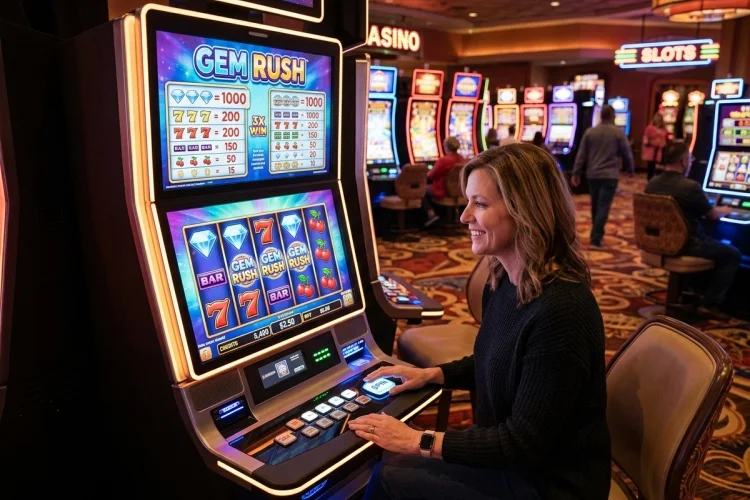
A slot machine is one of the easiest casino games to recognise. It usually has spinning reels, colourful symbols, a button or lever, and a paytable showing the available prizes.

Despite its simple appearance, plenty of technology and mathematics operate behind every spin. So, what is a slot machine, and how does it actually work?

In basic terms, it is a gambling game in which a player places a bet and receives a randomly determined combination of symbols. A prize is awarded when those symbols match one of the winning patterns listed in the game rules.

Modern versions may use physical reels, video screens, websites, or mobile apps, but they all follow this basic concept.

The Basic Purpose of a Slot Machine

A slot machine accepts a stake and produces a game result. Depending on the outcome, the player may receive no prize, a small return, a bonus feature, or a larger jackpot.

Unlike games such as poker or blackjack, standard slot results do not normally depend on a player’s strategic decisions. The main choices involve selecting the game, setting the stake, and deciding when to stop.

Gaming machines are also commonly called fruit machines, jackpot machines, or slots, although the exact terminology varies between countries.

Reels, Rows, and Symbols

Reels are the vertical columns containing symbols. Traditional machines generally use three physical reels, while video slots commonly display five or more virtual columns.

Rows run horizontally across the screen. A five-reel game with three rows displays 15 visible symbol positions.

Symbols can include numbers, fruit, playing-card icons, characters, or themed objects. Special symbols such as wilds, scatters, and bonus icons may substitute for other symbols or activate additional features.

How Paylines Create Winning Combinations

A payline is a pattern connecting symbol positions across the reels. It may run horizontally, diagonally, or in a zigzag shape.

For example, a game may require three matching symbols to appear from left to right on an active line. Matching symbols outside that pattern might not produce a prize.

Not every modern game uses traditional lines. Some offer hundreds of adjacent-reel combinations, while others pay for clusters of connected symbols. The game rules should clearly explain how wins are formed before a player places a wager.

What Happens When You Press Spin?

After the player selects a stake and presses spin, the game begins a new round. The system determines an outcome, displays the corresponding symbols, checks them against the paytable, and updates the balance.

On a mechanical machine, motors rotate and stop physical reels. Electronic machines can use a central processor to determine the result and direct reel motors to stop at the required positions.

In an online slot, the spinning reels are visual representations created by software. The animation displays the chosen result rather than physically generating it.

The Role of the Random Number Generator

Modern digital slots generally use a Random Number Generator, or RNG. This system continually generates numerical values that can be mapped to reel positions and game outcomes.

Regulatory standards require RNG-driven results to be statistically unpredictable. They also prohibit adaptive behaviour that changes outcomes simply to compensate for earlier wins or losses.

Each spin should therefore be treated as a separate event. A long losing sequence does not mean the next round must produce a prize.

How Payouts Are Calculated

The paytable lists each symbol’s value and the combinations needed to win. A payout may be shown as credits, a fixed amount, or a multiplier of the relevant stake.

Suppose three matching symbols award 15 times a $0.40 bet. The prize would be:

15 × $0.40 = $6

Always check whether the multiplier applies to the total stake, line bet, or coin value. These figures can produce very different results.

Understanding RTP and Volatility

Return to Player, usually shortened to RTP, is a theoretical percentage representing how much of the total money wagered may be returned as prizes over many rounds.

A 96% RTP does not promise that someone spending $100 will receive $96. The percentage is a long-term average, and an individual session may finish far above or below it.

Volatility describes how prizes may be distributed. Lower-volatility games generally offer smaller, more frequent returns, while higher-volatility games can produce longer gaps between prizes.

A slot machine is a chance-based game built around wagers, reels, symbols, and predefined payouts. Physical and digital versions may look different, but both generate a result and compare it with a paytable.

Modern slots commonly use RNG software to make each round unpredictable. Understanding reels, paylines, RTP, and volatility will not predict the next winning combination.

It simply helps players understand the rules and costs more clearly. Before playing, check local laws, read the paytable, confirm the total stake, and establish strict time and spending limits. Treat every slot as paid entertainment rather than a reliable source of income.

How to Play Online Slots: A First-Time Player’s Guide

How to Play Online Slots: A First-Time Player’s Guide

Elena Morales06/04/202608/05/2026

Playing an online slot for the first time can feel slightly confusing. The screen may contain reels, paylines, multipliers, bonus symbols, betting controls, and several buttons that are not immediately obvious.

Fortunately, learning how to play online slots does not require advanced technical knowledge. The basic process involves choosing a game, selecting a stake, pressing the spin button, and checking whether the symbols create a winning combination.

However, understanding the controls is only part of the preparation. New players should also know how paytables, Random Number Generators, Return to Player percentages, and spending limits work.

This beginner’s guide explains the process step by step while keeping the risks and practical realities clear.

Check That Online Gambling Is Legal

Before creating an account, confirm that online gambling is permitted in your location and that you meet the minimum legal age. Laws, licensing requirements, and consumer protections vary between countries and regions.

Choose only a platform licensed by a recognised regulator in the jurisdiction where you live. A licensed operator should provide information about its licence, game rules, customer support, privacy policy, and safer-gambling tools.

Avoid websites that hide their ownership or licensing details. A large welcome bonus does not make an unregulated platform trustworthy.

Start With a Demo Game

Demo mode lets you explore a slot using virtual credits rather than real money. It is a useful way to learn where the spin, bet, information, and settings buttons are located.

Use the practice version to see how quickly credits can rise or fall. Test different stake settings and open the game’s help section before considering real-money play.

Demo results should not be treated as evidence that the same pattern will continue with money. Each spin remains random, and a winning practice session does not predict future outcomes.

Read the Paytable Before Spinning

The paytable explains how the slot works. It shows symbol values, winning patterns, bonus triggers, jackpot rules, and any special features.

Some slots pay when identical symbols appear on traditional paylines. Others use clusters, adjacent reels, or hundreds of “ways to win.” Never assume that two games follow identical rules.

Regulated games may be required to display rules and prize information before a player commits money. Reading these details prevents confusion about why a particular symbol combination did or did not pay.

Choose a Small Total Stake

Slots may display stakes as coin values, line bets, betting levels, or one total amount. Check the final cost of a spin rather than focusing only on the smallest number shown.

For example, a game might display a coin value of $0.01 but apply it across multiple lines and levels. The actual total could therefore be much higher than one cent.

Start with the lowest practical setting while learning the interface. Increasing a bet does not make a winning result due or improve the predictability of the reels.

Press Spin and Understand the Result

After selecting the stake, press the spin button once. The game’s Random Number Generator chooses an outcome, and the reels animate to display the corresponding symbols.

Testing laboratories examine RNG systems to determine whether they produce unpredictable and statistically appropriate results. In regulated markets, games and RNGs may need testing before release.

Previous spins do not control the next one. Ten losses in a row do not guarantee that the following round will win.

Understand Wins and Net Results

When a combination wins, the game normally highlights the symbols and displays a prize. That prize is added to the account balance after the round.

A displayed win does not necessarily mean the player made a profit. If a $1 spin returns $0.40, the animation may celebrate a payout, but the net result is still a $0.60 loss.

Watch the balance rather than relying on sounds or visual effects. This provides a more accurate picture of the session.

Set Limits Before Using Real Money

Decide how much money and time you are prepared to spend before beginning. The amount should be affordable entertainment money, not cash needed for food, bills, rent, debt payments, or savings.

Deposit limits, time reminders, breaks, and self-exclusion tools can help players control their activity. GamCare specifically recommends limit setting, frequent breaks, and self-exclusion among its safer-gambling measures.

Never increase the stake simply to recover a loss. Chasing losses can turn a planned entertainment session into uncontrolled spending.

Learning how to play online slots begins with understanding the interface, not finding a secret winning method. Check local laws, use a licensed platform, practise in demo mode, and read the paytable carefully.

Once you understand the rules, select a small total stake and remember that every spin is unpredictable. Most importantly, establish firm money and time limits before playing.

Online slots should be treated as paid entertainment rather than a source of income. Start with free-play mode, examine the game information, and only consider real-money play when it is legal, affordable, and completely optional.

Recommended

  • Wild Symbol Weighting: Why More Wilds Do Not Always Mean More WinsWild Symbol Weighting: Why More Wilds Do Not Always Mean More Wins
  • Can Free Spins Be Retriggered? How Extra Spins WorkCan Free Spins Be Retriggered? How Extra Spins Work
  • What Is a Free Spins Bonus Round? A Simple Slot GuideWhat Is a Free Spins Bonus Round? A Simple Slot Guide
  • Does a Higher RTP Mean You Will Win More? The Real AnswerDoes a Higher RTP Mean You Will Win More? The Real Answer
Build stronger financial knowledge with practical insights into personal finance, investing, saving, budgeting, markets, business, and long term planning. Our financial content explains important concepts clearly while exploring strategies, trends, and economic developments that can help readers make more informed decisions, manage money responsibly, and understand changing financial opportunities responsibly.
Click Here
Visit Our Site
Learn More
Read More
Find Out More
Discover More
Explore More
See More
View More
Get Started
Start Here
Visit Now
Click to Learn More
Explore Now
Discover Now
Check It Out
Take a Look
View Details
See Details
Learn More Here
Find Out Here
Discover It Here
Explore Our Site
Visit the Website
Go to Website
Visit This Page
Open Website
Browse Our Site
Browse Now
Explore the Website
Find More Information
Get More Information
Read the Full Story
Read Full Details
View Full Details
See Full Information
Discover the Details
Explore the Details
Learn the Details
Check the Details
Continue Reading
Keep Reading
Read Further
Explore Further
Discover Further
Learn More Today
Explore Today
Discover Today
Visit Today
Check It Out Now
See What’s Inside
Discover What’s Inside
Explore What’s Inside
See What We Offer
Discover What We Offer
Explore Our Options
View Our Options
See Your Options
Explore Your Options
Discover Your Options

What’s New

  • Mythology Slots and the Lasting Power of Ancient Game WorldsMythology Slots and the Lasting Power of Ancient Game Worlds
  • Norse Mythology Slots: Gods, Runes, and Bonus Rounds ExplainedNorse Mythology Slots: Gods, Runes, and Bonus Rounds Explained
  • Compare Slots Better: Volatility, Hit Rate and Payout DistributionCompare Slots Better: Volatility, Hit Rate and Payout Distribution
  • Classic Fruit Slots: Why Simple Reels Still Feel FreshClassic Fruit Slots: Why Simple Reels Still Feel Fresh
  • About Us
  • Contact
  • Disclaimer
  • Privacy Policy
  • Terms & Conditions
  • Sitemap
© 2026 Synergie Solutions | Theme: BlockWP by Candid Themes.