
Skip to content

Recent Posts

  • Hacksaw Gaming Slots: Bonus Mechanics and Design Explained
  • Payline Slots vs Megaways Slots: Which Mechanics Change the Game?
  • Android Slots Guide: Should You Use an App or Mobile Browser?
  • How to Compare Volatility Using Free Play Without Guessing
  • Does a Progressive Jackpot Reduce Base Game RTP? The Real Math

Most Used Categories

  • Free Slots (6)
  • Megaways Slots (5)
  • Slot Themes (4)
  • Mobile Slots (4)
  • Slot Providers (3)
  • Slot Features (3)
  • Jackpot Slots (3)
  • Slot Guides (3)
  • Slot Reviews (3)
  • High-RTP Slots (2)
Skip to content
Synergie Solutions Web

Synergie Solutions Web

Subscribe
  • Jackpot Slots
  • Megaways Slots
  • Mobile Slots
  • Slot Features
  • Slot Providers
  • Slot Guides

Home › Jackpot Slots

Category: Jackpot Slots

Does a Progressive Jackpot Reduce Base Game RTP? The Real Math

Does a Progressive Jackpot Reduce Base Game RTP? The Real Math

Elena Morales09/05/202609/19/2026

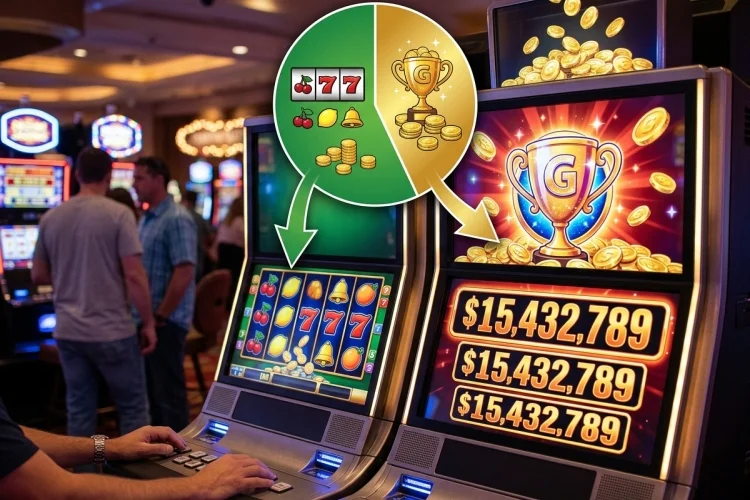
A progressive slot might display an RTP of 95% or 96%, yet ordinary gameplay can sometimes feel very different from a regular slot carrying the same percentage. The reason may be hidden in how the theoretical return is divided.

That leads to the question: Does a Progressive Jackpot Reduce Base Game RTP? In some progressive designs, a portion of the overall return is assigned to jackpot prizes, leaving a smaller percentage for regular gameplay.

But that is a design choice, not a universal rule. To compare games properly, you need to understand total RTP and its individual components.

RTP Is a Budget for Theoretical Payouts

A useful way to understand RTP is to think of it as a mathematical payout budget.

Imagine a slot designed with a theoretical 96% return.

That percentage could be distributed among several parts of the game: normal symbol wins, Free Spins, bonus features, fixed jackpots, and a progressive prize.

A non-progressive game might theoretically allocate the complete 96% across its regular features.

A progressive game could instead divide that expected return between ordinary gameplay and jackpot awards.

Regulators recognise this distinction. UK Gambling Commission standards state that progressive jackpot RTP may be presented either as one combined percentage or broken down into base-game and jackpot components.

So a single headline number does not necessarily describe regular reel play alone.

A Simple Progressive RTP Example

Consider a fictional progressive slot with the following mathematical allocation:

Base-game wins: 92.5%

Bonus features: 1.5%

Progressive jackpot: 2%

Combined theoretical RTP: 96%

Here, ordinary gameplay plus bonuses accounts for 94%, while 2% of the theoretical value comes through the jackpot mechanism.

Now compare that with a regular slot where the entire 96% is delivered through standard wins and features.

Both may technically carry the same overall RTP.

However, their payout distribution is not the same.

The progressive title concentrates part of its expected return into an infrequent high-value event. That difference can heavily influence the experience of short and medium sessions.

These figures are only an ilustrative example, not a universal jackpot formula.

Why Progressive Games Separate Jackpot Value

A progressive prize increases because qualifying play contributes to a jackpot system.

The Gambling Commission defines progressive jackpots as incremental prizes that grow from contributions associated with money staked in the game.

Modern systems can be local, linked across several games, or networked across multiple operators.

Pragmatic Play’s Power Jackpot, for example, uses four separate progressive tiers and states that fixed percentages from jackpot-game wagers feed those pools.

The actual accounting can include a seed amount, reserves, overflow pools, and reset values.

Because of those elements, you should avoid assuming that every dollar added visibly to a meter maps directly to an equal percentage of advertised RTP.

Base Game RTP Can Be Lower Without Changing Total RTP

This is the most important point.

Adding a progressive jackpot does not mathematically require the total RTP to fall.

A developer could reduce the base-game portion and redirect that theoretical value toward the jackpot while leaving total RTP unchanged.

Imagine Game A:

96% base-game RTP
No progressive jackpot

Now consider Game B:

93.5% base-game RTP
2.5% progressive component
96% combined RTP

Game B has the same total theoretical percentage but a lower base component.

In that scenario, the answer to the question is clearly yes: the progressive structure reduces the share returned through base play.

However, this does not prove that every progressive game follows that exact model.

Each certified game must be considered individually.

Why the Base Game May Feel “Tighter”

Large jackpots normally occur much less often than standard reel wins.

If part of a game’s RTP is concentrated inside a rare progressive event, most players will experience ordinary gameplay without ever seeing that portion returned directly to them.

This does not mean the RTP figure is fake.

It means RTP is calculated across the complete mathematical model and a huge number of wagers, including rare outcomes.

The UK Gambling Commission notes that progressive jackpots are sufficiently infrequent and large that their RTP performance can be difficult to evaluate using ordinary live monitoring. For that reason, it recommends monitoring the base game and progressive component separately.

That separation illustrates how different their payout behaviour can be.

Jackpot Contribution and RTP Contribution Are Different Ideas

Suppose a jackpot meter increases by a certain percentage of wagers.

It is tempting to say that percentage automatically equals the jackpot’s RTP contribution.

That shortcut can be misleading.

Part of the money may support the displayed progressive amount, while other portions may help reseed the jackpot after it is won or enter a reserve pool.

UK jackpot standards specifically require rules to explain funding, starting seed amounts, ceiling values, and how contributions are handled when limits apply.

Gaming Laboratories International also sets requirements for calculating progressive jackpot RTP and managing player-funded jackpot amounts.

For an accurate figure, use the game’s official theoretical RTP information rather than estimating from how quickly the meter moves.

Can the Growing Jackpot Change Expected Value?

Potentially, depending on the system.

If the probability of triggering a jackpot remains constant while the prize grows, the expected value of that jackpot event can rise with the meter.

The principle is easy to understand mathematically.

Suppose an event has a one-in-one-million probability. Increasing its prize from $500,000 to $1 million changes the expected return associated with that event, assuming everything else remains unchanged.

Progressive casino calculations often treat the current jackpot as a variable when determining theoretical return. Wizard of Odds, for example, separates fixed-award returns from jackpot-dependent returns in its progressive Casino Hold’em calculations.

However, slot systems can use very different rules.

Do not assume a progressive meter automatically makes a game positive expectation or dramatically improves its RTP.

Minimum Bets Can Also Matter

Some progressive systems require a specific qualifying wager before a player becomes eligible for the jackpot.

That condition matters when evaluating RTP.

GLI standards state that if a minimum bet is required for eligibility, the base game excluding the progressive jackpot must still meet the applicable minimum player-return requirements.

Modern online games can also handle eligibility in different ways.

Some jackpots are active at every stake, while others may require specific betting conditions.

Always read the jackpot rules before using the displayed prize as part of your comparison.

A huge progressive meter has no practical relevance if your selected wager is not eligble for it.

How to Compare Two Jackpot Slots Properly

Do not compare progressive games using jackpot size alone.

Start with the published total RTP and check whether it includes the progressive component. Next, find the base-game percentage if the developer publishes it separately.

Then examine volatility.

A game with substantial theoretical value tied to extremely rare jackpots may distribute returns differently from a game whose value is concentrated in more frequent regular wins.

You should also check the reset amount, jackpot structure, trigger conditions, qualifying stake, and whether the prize is local or networked.

Finally, confirm the exact game version.

Casinos and developers can sometimes offer different RTP configurations, so numbers from a review site may not always match the version actually loaded on your screen.

Higher Jackpot Does Not Mean It Is Due

A jackpot growing for weeks or months may look as though it must be close to paying.

For ordinary random progressives without a documented must-hit threshold, that conclusion does not follow.

Past unsuccessful spins do not by themselves make the next independent RNG result more likely to trigger the prize.

The current jackpot size can affect the monetary value of winning it, but this is seperate from saying that the win is “due.”

That distinction is important when thinking about progressive RTP.

RTP describes mathematical expected return over very large samples. It does not predict the timing of a jackpot or tell an individual player when to expect a major payout.

Does a Progressive Jackpot Reduce Base Game RTP? It can when part of the theoretical payout budget is redirected from regular gameplay into the progressive prize, although this varies by game.

Always distinguish base RTP, jackpot RTP, and combined RTP before making comparisons. Check the official paytable and jackpot rules rather than relying only on the headline percentage or jackpot amount.

What Is a Network Progressive Jackpot? A Simple Guide

What Is a Network Progressive Jackpot? A Simple Guide

Elena Morales07/11/202608/05/2026

A jackpot can grow much faster when it is connected to more than one game. Instead of relying on wagers from a single slot, a shared system may collect qualifying contributions from games across several casino floors, websites, or participating venues.

This setup is commonly called a Network Progressive Jackpot. In technical standards, it may also be described as a linked or multi-site jackpot, depending on how widely the participating games are distributed.

The larger network can help the advertised prize rise quickly, but it does not guarantee that an individual player has better odds. Understanding how the pool, trigger, eligibility rules, and central controller work is essential before placing a wager.

How a Network Jackpot Is Defined

A progressive jackpot is a prize that increases from a starting value as qualifying gameplay contributes to it. A network version connects several participating games to one common prize.

Gaming Laboratories International distinguishes between three arrangements: standalone jackpots, linked jackpots, and multi-site jackpots. A multi-site system connects a linked prize across multiple gaming venues and may also include interactive gaming systems where permitted.

The term “network jackpot” is therefore a practical description rather than one universal regulatory category.

How the Prize Pool Grows

The jackpot begins with a seed or reset amount. As eligible wagers are placed, a predefined contribution is added to the prize pool.

Suppose a network collects 0.5% of qualifying turnover. If participating games process $2 million in eligible wagers, the pool would receive:

$2,000,000 × 0.5% = $10,000

This calculation is only an example. The actual increment method must be explained in the official rules. UK technical standards require disclosure of the funding method, starting seed, and any jackpot ceiling.

What the Central Controller Does

A network system needs technology to collect contributions, calculate the current prize, and communicate that value to every participating game.

Under GLI’s multi-site model, local controllers gather contributions from connected gaming equipment and send them to a central controller. The central controller increases the jackpot and distributes the updated amount back to participating locations and displays.

This process keeps the shared prize synchronised across the network.

How the Jackpot Is Triggered

A jackpot may be awarded through a specific symbol combination, a bonus game, or a mystery trigger selected by an approved random system.

The winning method should be described in the paytable or jackpot information page. Regulated game rules should explain what constitutes a win, whether wagers contribute to a progressive prize, and how that prize operates.

A growing meter does not show that the award is about to be triggered. The amount and the winning probability are separate parts of the game.

Does Every Wager Qualify?

Not necessarily. Some network jackpots require a minimum bet, an optional side wager, a particular number of active lines, or participation in a specific game mode.

The jackpot rules should clearly identify ineligible players and state the relevant theoretical RTP when the progressive prize cannot be won.

Always check the full cost of qualification. A higher stake may provide access to the jackpot, but it also makes the balance decline faster.

What Happens After a Win?

After a qualifying player wins, the jackpot normally returns to its published reset value. New eligible contributions then begin increasing the prize again.

The central system communicates the win and reset across participating locations. Technical standards also cover situations where network timing makes two triggers appear simultaneous, ensuring that the award process follows published rules.

A recently reset jackpot can theoretically be triggered again at any time.

RTP and Volatility

The game may show one combined RTP covering the base slot and progressive component, or separate percentages for each.

Network jackpots are generally rare and potentially very large, which makes them highly volatile. The UK Gambling Commission recommends monitoring the base game separately because occasional jackpot wins can heavily distort performance data.

RTP remains a long-term theoretical measurement rather than a promise for one session.

A Network Progressive Jackpot connects multiple eligible games to one growing prize. Contributions are gathered by local systems, combined through a central controller, and displayed across the participating network.

The prize continues increasing until the published winning event occurs, after which it normally resets to a seed value. Before playing, check the qualifying stake, trigger method, jackpot contribution, RTP, and current prize rules.

Do not assume that a larger network or growing meter makes a win more likely. Use only an affordable entertainment budget, monitor the total amount wagered, and stop when your predetermined money or time limit is reached.

Progressive Jackpots vs Fixed Jackpots: Key Differences

Progressive Jackpots vs Fixed Jackpots: Key Differences

Elena Morales07/07/202608/05/2026

A jackpot is usually the largest prize available in a slot game, but not every jackpot follows the same structure.

Some have a stable value that remains unchanged, while others grow as qualifying wagers are placed across one or more connected games.

This comparison of Progressive Jackpots vs Fixed Jackpots explains the main differences in simple terms. We will look at prize values, funding methods, winning conditions, resets, and Return to Player percentages.

Neither format guarantees a win. A progressive prize may be much larger, but it can also depend on an extremely rare event. A fixed jackpot is easier to understand, although its maximum award is generally more limited.

What Is a Fixed Jackpot?

A fixed jackpot offers a predetermined top prize. Its value does not increase simply because more people play the game.

For example, a slot might pay 10,000 times the triggering stake for its highest symbol combination. With a qualifying $0.50 bet, the award would be:

10,000 × $0.50 = $5,000

The amount may still vary with the player’s stake. What remains fixed is the multiplier or prize structure stated in the paytable.

What Is a Progressive Jackpot?

A progressive jackpot begins with a starting amount, commonly called a seed, and can grow until someone wins it. Some of the qualifying wagering activity may contribute to the expanding prize pool.

Regulated jackpot rules should explain how the pool is funded, its seed value, any maximum ceiling, and what happens to additional contributions after the ceiling is reached.

After the jackpot is awarded, the displayed amount normally returns to its seed and begins increasing again.

How Different Progressive Networks Work

A standalone progressive is connected to one game or machine. A local system can link several games within the same platform or venue.

A multi-site or networked system combines eligible activity across a wider collection of participating games. GLI’s current progressive-jackpot standard distinguishes between standalone, linked, and multi-site implementations.

A larger network may make the prize grow faster because more qualifying activity contributes. This does not necessarily mean an individual player has a better chance of winning.

How Winning Conditions Differ

A fixed jackpot may require a particular symbol combination, such as five premium symbols on an active route. The payout is then calculated using the game’s fixed prize table.

Progressive prizes can also use symbol combinations, but some rely on bonus wheels, mystery events, or randomly selected jackpot triggers. The active rules should describe exactly how the prize is determined and awarded.

Previous spins do not make either type of jackpot due. Each qualifying round remains subject to the game’s programmed probability model.

Do All Stakes Qualify?

Fixed jackpots may scale with the wager, although some games require a particular betting level to unlock the maximum payout.

Progressive jackpots can have stricter eligibility conditions. A minimum stake, jackpot side bet, selected mode, or specific number of active lines may be required.

UK technical standards state that ineligible players should be clearly informed, along with the theoretical RTP applying when the progressive component is unavailable.

Always verify eligibility before assuming the headline amount can be won.

How RTP Can Be Displayed

A fixed-jackpot game generally includes the top prize within its overall theoretical RTP calculation.

For progressive games, the RTP can be displayed as one combined figure or separated into the base game and jackpot contribution. The base game may also need to be monitored independently from the progressive component.

RTP is an expected return across extended play. It does not guarantee that one player will recover a particular percentage during a short session.

Which Format Is More Volatile?

Progressive games are often highly volatile because part of their payout value can be concentrated in a very rare, extremely large prize.

Fixed jackpots may have a smaller maximum payout and a simpler distribution. However, a fixed-jackpot game can still be highly volatile if its largest ordinary wins are uncommon.

The jackpot type alone does not reveal the full risk. Players should also check volatility, regular symbol payouts, bonus frequency, and stake size.

Fixed jackpots offer a stable top prize based on a predetermined paytable. Progressive jackpots begin with a seed and can grow through qualifying activity until a winning event triggers the award.

Progressive systems may connect one game, a local group, or a multi-site network.

Neither format guarantees better short-term results. Before playing, confirm the trigger, required stake, prize calculation, RTP, and whether the jackpot resets or remains fixed.

Use the official rules rather than relying on the headline amount. Set a firm entertainment budget, and never increase spending simply because a progressive meter appears unusually large.

Recommended

  • Wild Symbol Weighting: Why More Wilds Do Not Always Mean More WinsWild Symbol Weighting: Why More Wilds Do Not Always Mean More Wins
  • Can Free Spins Be Retriggered? How Extra Spins WorkCan Free Spins Be Retriggered? How Extra Spins Work
  • What Is a Free Spins Bonus Round? A Simple Slot GuideWhat Is a Free Spins Bonus Round? A Simple Slot Guide
  • Does a Higher RTP Mean You Will Win More? The Real AnswerDoes a Higher RTP Mean You Will Win More? The Real Answer
Build stronger financial knowledge with practical insights into personal finance, investing, saving, budgeting, markets, business, and long term planning. Our financial content explains important concepts clearly while exploring strategies, trends, and economic developments that can help readers make more informed decisions, manage money responsibly, and understand changing financial opportunities responsibly.
Click Here
Visit Our Site
Learn More
Read More
Find Out More
Discover More
Explore More
See More
View More
Get Started
Start Here
Visit Now
Click to Learn More
Explore Now
Discover Now
Check It Out
Take a Look
View Details
See Details
Learn More Here
Find Out Here
Discover It Here
Explore Our Site
Visit the Website
Go to Website
Visit This Page
Open Website
Browse Our Site
Browse Now
Explore the Website
Find More Information
Get More Information
Read the Full Story
Read Full Details
View Full Details
See Full Information
Discover the Details
Explore the Details
Learn the Details
Check the Details
Continue Reading
Keep Reading
Read Further
Explore Further
Discover Further
Learn More Today
Explore Today
Discover Today
Visit Today
Check It Out Now
See What’s Inside
Discover What’s Inside
Explore What’s Inside
See What We Offer
Discover What We Offer
Explore Our Options
View Our Options
See Your Options
Explore Your Options
Discover Your Options

What’s New

  • Hacksaw Gaming Slots: Bonus Mechanics and Design ExplainedHacksaw Gaming Slots: Bonus Mechanics and Design Explained
  • Payline Slots vs Megaways Slots: Which Mechanics Change the Game?Payline Slots vs Megaways Slots: Which Mechanics Change the Game?
  • Android Slots Guide: Should You Use an App or Mobile Browser?Android Slots Guide: Should You Use an App or Mobile Browser?
  • How to Compare Volatility Using Free Play Without GuessingHow to Compare Volatility Using Free Play Without Guessing
  • About Us
  • Contact
  • Disclaimer
  • Privacy Policy
  • Terms & Conditions
  • Sitemap
© 2026 Synergie Solutions | Theme: BlockWP by Candid Themes.