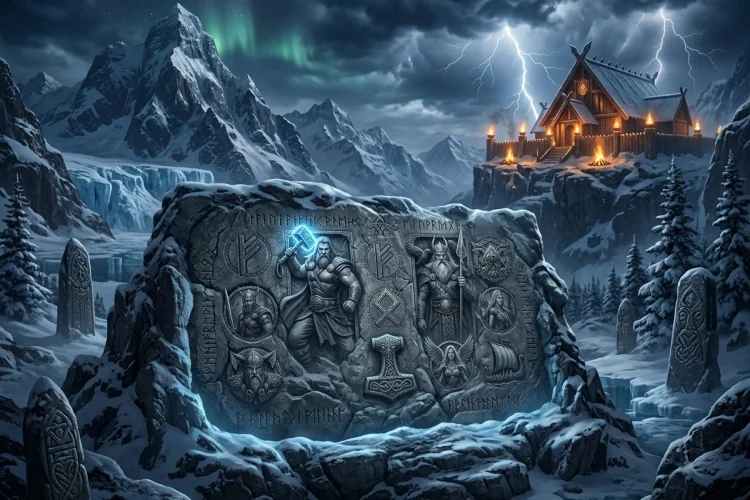
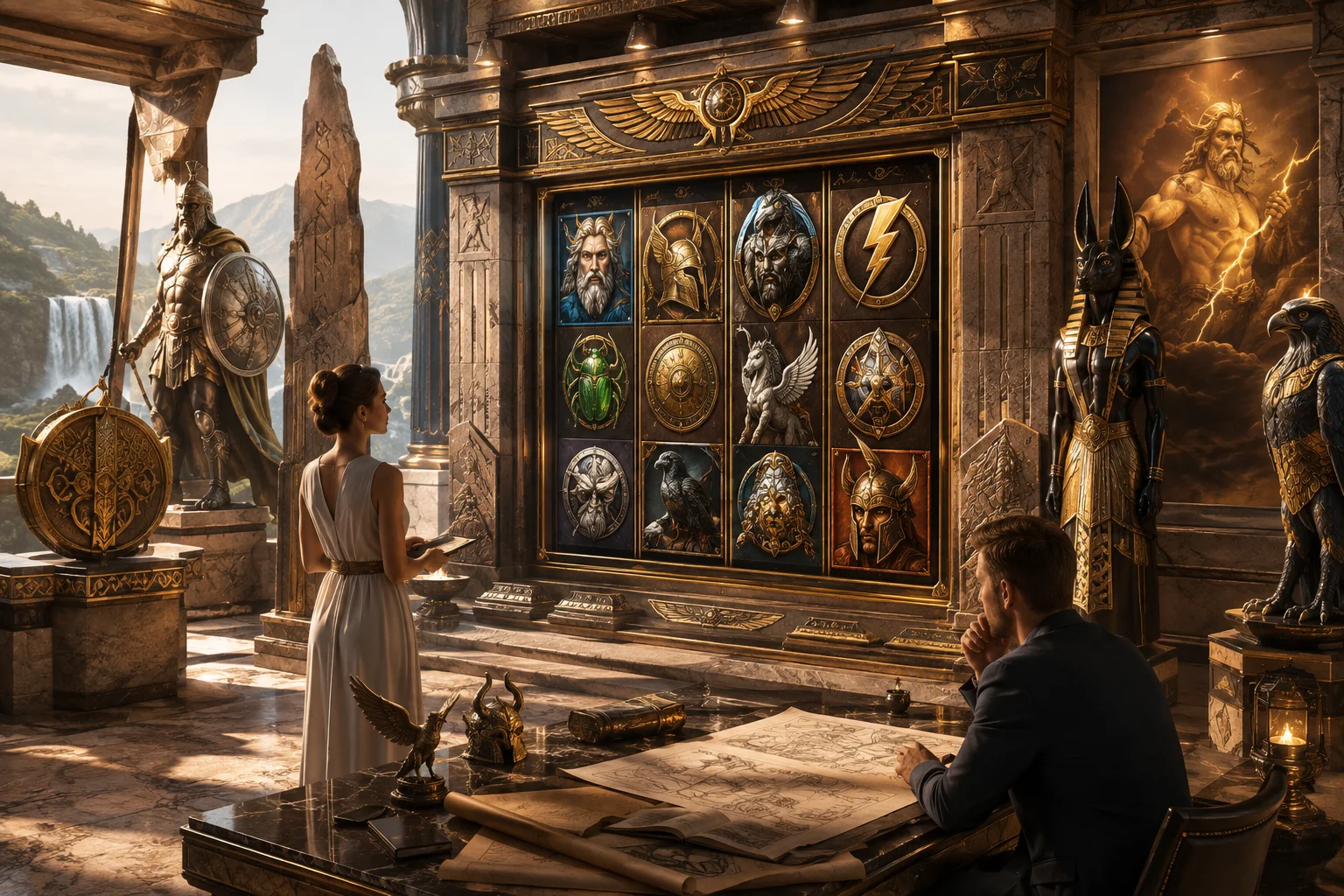
Why do game lobbies keep returning to Olympus, Egyptian tombs, Norse gods, and legendary heroes when developers could invent completely new worlds?
The answer is not simply nostalgia.
Mythology Slots give designers a rare combination of familiarity and freedom. Ancient stories come with memorable characters, powerful symbols, dramatic locations, supernatural abilities, and conflicts that can be translated directly into modern game mechanics. At the same time, mythology is flexible enough to be retold in serious, colourful, comedic, futuristic, or highly stylised ways.
The wider games industry has also repeatedly adapted ancient Greece, Rome, Egypt, and other mythological traditions. Academic work on classical reception now treats video games as an important part of how modern audiences encounter and reinterpret the ancient world.
That makes mythology unusually suited to continual reinvention.
Ancient Myths Already Contain Game-Like Structures
Many myths naturally resemble game scenarios.
A hero receives a task.
They travel into dangerous territory.
They face monsters.
They collect powerful objects.
They confront a final enemy.
Hercules and his famous trials are an obvious example.
Play’n GO has continued using Hercules in modern slot design, including 13th Trial Hercules Abyssways, where mythological obstacles and characters are integrated into changing gameplay states.
The story already provides progression.
A designer does not need to invent why the hero is fighting monsters or entering another realm.
That makes mythology a natural foundation for bonus rounds, collection mechanics, expanding grids, transformations, and staged features.
Mechanics can feel like chapters of the myth rather than unrelated effects.
Mythological Powers Translate Easily Into Mechanics
Ancient gods conveniently have very clear abilities.
That is almost perfect for feature design.
Zeus controls lightning.
Poseidon controls the sea.
Hades rules the underworld.
Thor has his hammer.
Anubis is strongly associated with death and the afterlife.
These characteristics can become wild transformations, multipliers, respins, symbol destruction, or bonus triggers.
Pragmatic Play’s Gates of Olympus connects Zeus with random multiplier symbols during tumbling sequences, while Zeus vs Hades – Gods of War uses the rivalry between two gods to frame different game modes.
This is efficient visual communication.
If lightning strikes the grid and increases a multiplier, the event feels thematically logical.
Compare that with an unrelated theme where a multiplier appears for no narrative reason.
The numbers may be identical.
The first design simply has stronger thematic context.
Ancient Settings Provide Strong Visual Identity
Slot games need to establish atmosphere quickly.
Mythology offers ready-made architectural and visual languages.
Greek themes can use temples, marble statues, mountains, lightning, armour, laurel leaves, and gold.
Egyptian themes can use deserts, tombs, pyramids, scarabs, pharaohs, hieroglyphics, and funerary imagery.
Play’n GO’s Book of Dead is a clear example of how Ancient Egypt can support an entire visual world built around tomb exploration and the afterlife.
The setting also creates natural locations for bonuses.
A temple door can open into Free Spins.
A tomb can reveal a mystery symbol.
An underworld scene can signal a higher-volatility mode.
A mountain peak can introduce a god character.
The enviroment becomes part of feature communication.
Familiar Stories Lower the World-Building Barrier
Inventing a completely original fantasy universe requires explanation.
Who is the king?
Why is the villain dangerous?
What is the magical object?
Why should anyone care about the temple?
Mythology can skip much of that setup.
Many audiences already have at least some awareness of Zeus, Hercules, Medusa, pyramids, Vikings, or Egyptian gods through films, books, games, school, and popular culture.
Research on classical reception demonstrates how ancient material has repeatedly circulated through later cultural forms, while scholarship on games increasingly studies interactive adaptations as part of that ongoing process.
This does not mean every player knows the original myths accurately.
They do not need to.
A rough cultural association can be enough.
Lightning god.
Ancient tomb.
Hero versus monster.
Those concepts are immediately usable.
That saves valuable screen time and reduces the amount of explenation required.
Mythology Can Support Very Different Mathematical Profiles
A mythological theme does not lock a developer into one kind of slot.
The same Zeus character can support completely different mathematical systems.
For example, Pragmatic Play’s Zeus vs Hades – Gods of War offers a choice between Olympus and Hades. Olympus has a higher probability of reaching the bonus but a lower average bonus win, while Hades triggers the feature less frequently but offers a higher average win when it occurs.
The mythological opposition becomes a way to present volatility differences.
Another Zeus game might focus on cluster pays.
Another could use paylines.
Another can revolve around multipliers.
This flexibility is important commercially and creatively.
Developers can keep a recognisable theme while rebuilding the underlying mechanics.
That makes mythology particularly suitable for sequels and related titles.
Ancient Themes Work Well With Series and Franchises
A strong mythological character can be reused without feeling completely out of place.
Pragmatic Play has expanded the Olympus concept through titles such as Gates of Olympus, Gates of Olympus 1000, Gates of Olympus Super Scatter, and Fortune of Olympus.
Play’n GO has also repeatedly revisited Greek mythology, publishing collections that include Zeus, Hades, Poseidon, Hercules, and other ancient figures.
This demonstrates another design advantage.
Mythology acts almost like a shared narrative toolbox.
A sequel can change the mechanics without abandoning the world.
A designer can introduce a different god.
A spin-off can focus on one legendary object.
A new game can reinterpret an existing conflict.
The cultural source material is broad enough to keep producing variations.
Mythological Worlds Can Mix Familiarity With Novelty
The biggest danger with ancient themes is repetition.
Another golden temple and another Zeus character can quickly look like something players have already seen.
The solution is not necessarily abandoning mythology.
It is interpreting it differently.
Play’n GO’s Pandora’s Box of Evil, for example, takes the familiar Pandora story and builds its own stylised version around hope, magic, and monsters.
Its 13th Trial Hercules Abyssways similarly reworks Hercules through a distinctive visual identity and newer mechanics rather than simply repeating a generic ancient-temple template.
This is where good art direction becomes essential.
The myth supplies familiarity.
The designer supplies novelty.
Without that second part, the theme can feel formulaic.
Mythology Also Works Across Different Cultures
Greek mythology may be especially common, but ancient-theme design is much broader.
Egyptian, Norse, Roman, Chinese, Mesoamerican, Indian, Japanese, and other traditions provide different characters, architecture, legends, and symbolic systems.
This creates enormous creative possibilities.
It also creates responsibility.
Ancient cultures should not be treated as interchangeable collections of exotic symbols.
Academic research into historical and mythological representation in games increasingly examines authenticity, cultural interpretation, and the ways ancient material is reconstructed for modern audiences.
Developers do not have to create museum exhibits.
A fantasy slot can be exaggerated and imaginative.
But stronger research usually creates a richer world and avoids lazy combinations.
That becomes especially relavent when games are distributed internationally.
Mythology Creates Strong Mechanic-Theme Alignment
The most successful ancient-themed games tend to connect what the feature does with what the mythology suggests it should do.
A thunder god creates multipliers.
A sea god floods reels.
A phoenix might respawn.
A legendary book reveals hidden symbols.
A monster destroys positions.
A hero progresses through trials.
This is stronger than simply placing mythological artwork around a generic slot engine.
Play’n GO’s own mythology-focused releases frequently connect characters and story events with specific features, while Pragmatic Play’s Zeus-based titles similarly use lightning, gods, Olympus, and multipliers as parts of one visual-mechanical language.
When theme and mechanic support each other, the rules become easier to remember.
That is one of mythology’s biggest design advantages.
The ancient story does not just decorate the feature.
It helps explain it.
Mythology Slots continue to work because ancient worlds offer game designers ready-made heroes, villains, symbols, conflicts, and supernatural powers. They support everything from multipliers to evolving bonus rounds while remaining flexible enough for sequels and reinterpretations.
The strongest modern designs keep the familiar mythology but introduce fresh mechanics, art direction, and cultural detail so the theme feels renewed rather than recycled.