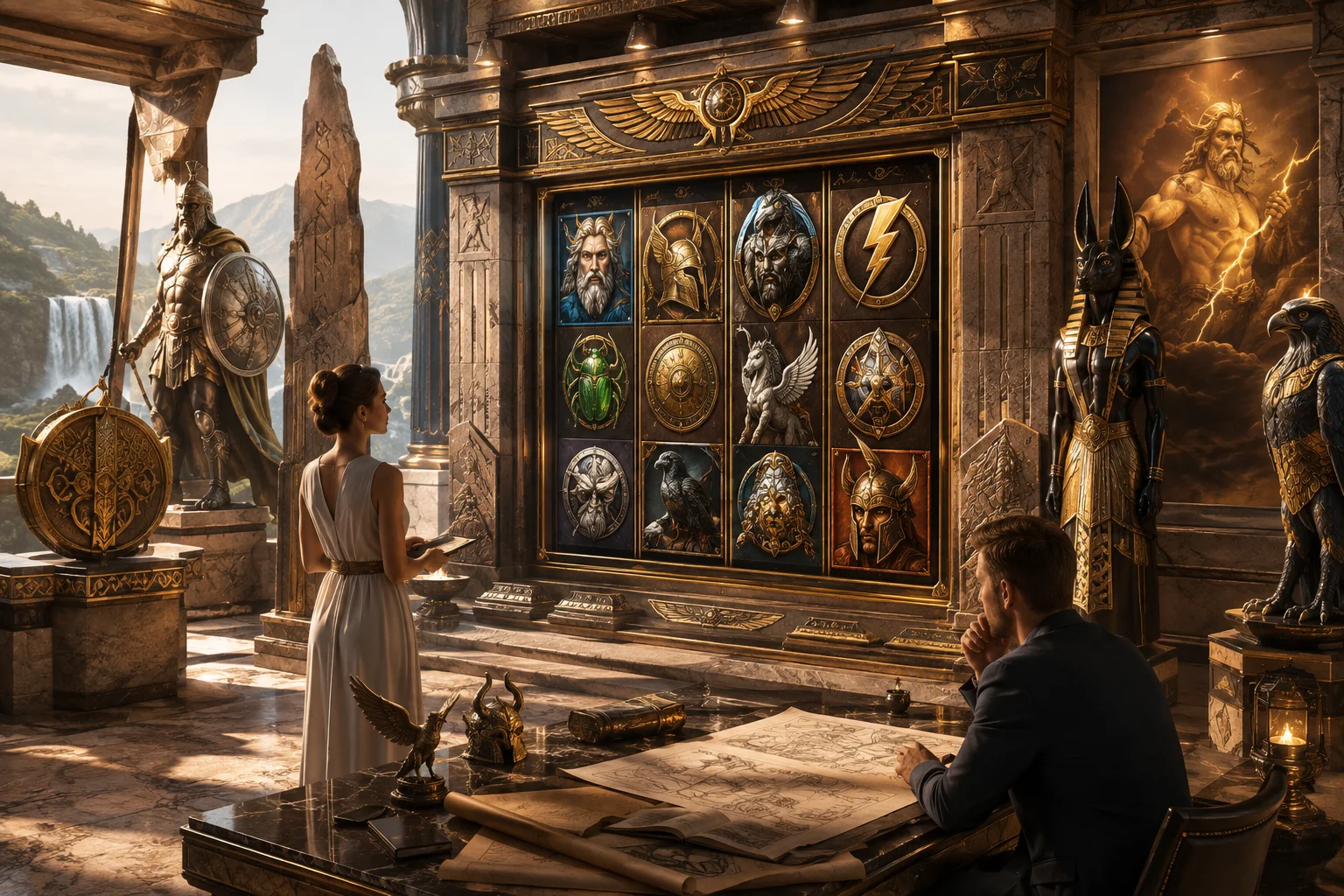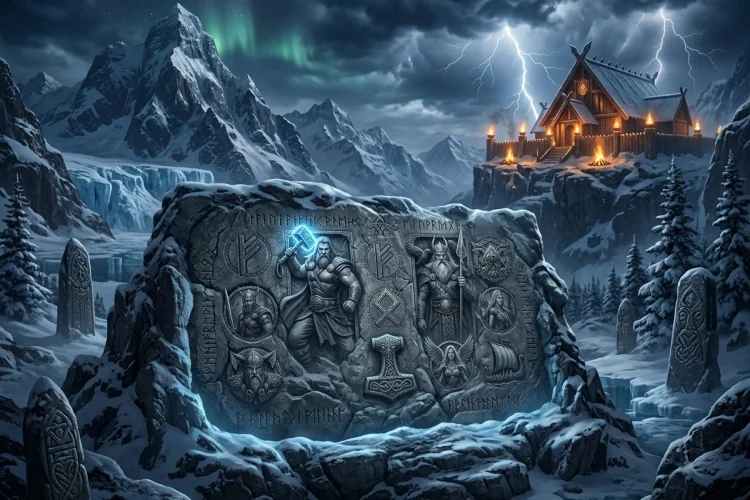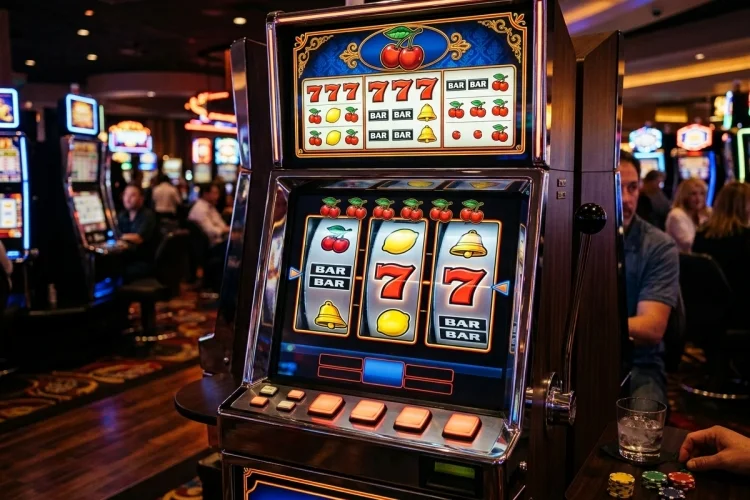
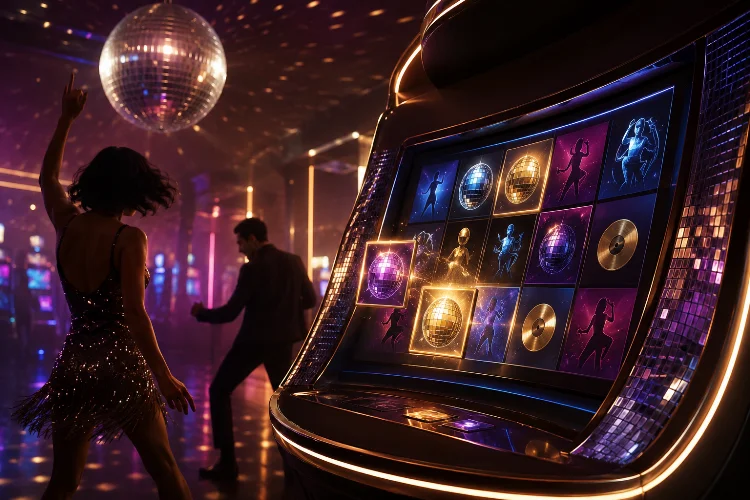
The easiest slot mechanics to understand are often the ones that do not feel like mechanics at all. A buffalo stampede fills the reels with wilds. A treasure hunt increases a reward meter. A dance-floor game becomes more energetic as winning symbols disappear and the playing area expands.
These are examples of Theme-Mechanic design working properly.
A Modern Online Slot may contain complex probability systems underneath the interface, but players experience those systems through characters, environments, animation, and sound. Funk Master, for example, connects its disco identity with Dancing Wilds, Cluster Pays, Avalanches, and an expanding play area during Free Spins.
The mathematics still matters most for determining outcomes. Yet the theme can determine whether those outcomes feel coherent, memorable, and easy to follow.
Theme Can Define the Rhythm of Gameplay
Not every slot should move at the same pace.
A classic fruit-machine theme often works with direct interactions. Spin, evaluate, pay, repeat.
A cinematic adventure game can support a slower progression structure where several events gradually lead toward a larger feature.
Theme therefore influences the perceived rhythm of gameplay.
Imagine an underwater treasure game.
Collecting keys over several events can feel natural because searching and discovery are already part of the fictional setting. The same collection system inside a minimalist fruit slot could feel unnecessarily complicated.
Ocean’s Treasure uses an Atlantis-inspired environment alongside Stacked Wilds and Free Spins with an increasing level multiplier. Evolution also describes it as a high-volatility game with the possibility of substantial additional Free Spins.
The underwater exploration theme helps progression feel deliberate rather than arbitrary.
Visual Events Can Represent Changes in Mathematical State
Modern slots frequently switch between different game states.
The base game might use ordinary rules. A bonus can introduce extra wilds. Later stages may increase multipliers or change reel dimensions.
Players do not need to think of these technically as state transitions.
Theme can make those transitions visible.
For example, the screen might move from a quiet village into a dragon’s lair. The reels expand, the soundtrack changes, and wilds begin locking into place.
The visuals tell the player that a different ruleset is now active.
This is one reason Theme-Mechanic design is valuable. It turns an abstract mathematical transition into something that can be recognised immediately.
Good thematic signalling reduces the amount of explenation needed without removing the need for clear game rules.
Feature Names Should Describe What Players Actually See
Feature naming is another small but important part of alignment.
A mechanic called “Buffalo Stampede” makes sense if buffalo-related Wilds actually rush onto the grid.
Buffalo Mania Megaways does precisely this. Its Buffalo Stampede feature can place multiple Buffalo Wilds on the reels, while Super Wilds can cover whole reels and interact with Ways Multipliers.
That creates a direct connection between name, animation, and function.
Imagine instead that Buffalo Stampede simply added an invisible 2% modifier somewhere in the background.
The name would have little relationship with the player’s experience.
Strong feature naming gives players clues about what is occurring.
It does not have to explain the exact probability, but the fictional event and mechanical event should point in the same direction.
Theme Can Make Wild Behaviour Easier to Understand
Wild symbols have become increasingly complicated.
A basic Wild substitutes for another symbol. Modern games may include expanding Wilds, moving Wilds, multiplier Wilds, sticky Wilds, or Wilds that transform nearby symbols.
Without visual logic, these differences can become confusing.
Theme helps make them intuitive.
Funk Master’s Dancing Wild fits its disco setting while participating in winning clusters and interacting with the Avalanche mechanic.
A military-themed game could represent a moving Wild as a vehicle advancing across the grid. An exploration slot could use a torch that reveals additional positions.
The underlying rules might be similar, but the theme gives each version a distinct identity.
This makes the mechanic easier to remember because behaviour and presentation reinforce one another.
Reward Hierarchy Can Follow the Story
Slot games need to communicate which events are ordinary and which are important.
Theme can build that hierarchy.
Basic symbols might represent common objects from the fictional world. Premium symbols can represent important characters. Scatters might represent a destination, while the highest feature state represents completion of the story.
This hierarchy becomes especially useful in games containing several progression levels.
Space Wars 2 Powerpoints uses collected Powerpoints to feed a multiplier system and determine Free Spins awards at different thresholds.
The science-fiction idea of building energy gives meaning to increasing numerical values.
Without that concept, players would simply see a meter increasing from one arbitrary number to another.
Theme creates contexual meaning around progression.
The same mathematics can become much easier to understand when every level represents something familiar inside the game world.
Theme Can Affect How Volatility Feels
Theme does not determine mathematical volatility, but presentation can influence how players experience quieter periods.
Consider a highly volatile game where major wins and bonus states are relatively uncommon.
If nothing happens between those events, the game may feel static.
A well-integrated theme can create visual progression, collections, environmental changes, or character responses without necessarily increasing the probability of winning.
This distinction is important.
A progress animation may provide entertainment without having any mathematical effect unless the rules say otherwise.
GLI’s RTP analysis treats volatility and contributions from feature games as mathematical characteristics that can be evaluated independently from the visual theme.
So an active-looking game is not automatically a frequently paying game.
Theme can change the feel of pacing without secretly changing the numbers underneath.
Mechanics Should Support the Fantasy, Not Fight It
Theme-Mechanic alignment is easiest to notice when it goes wrong.
Imagine a calm gardening slot where every win launches explosions, missiles, and collapsing buildings.
The feature might be technically impressive, but it conflicts with the fictional experience.
Now imagine plants growing after successful combinations, larger flowers becoming Wilds, and completing a garden unlocking Free Spins.
The same concepts—expansion, transformation, and progression—fit much more naturally.
This is why developers often select mechanics according to thematic verbs.
Adventure suggests exploring and discovering. Mining suggests digging and exploding. Music suggests rhythm and building energy. Fishing suggests collecting and catching.
These associations give designers a useful framework for selecting features.
The result can feel more intentional than taking a generic feature package and applying new artwork.
Good Alignment Also Improves Mobile UX
Theme-Mechanic design matters even more on a mobile screen.
There is less space for explanatory panels, large paytables, and persistent instructions.
Visual communication therefore becomes important.
If a multiplier is represented as a clearly growing rocket, players can understand its progression without dedicating a large section of the screen to text.
Space Wars 2 Powerpoints uses a multiplier rocket powered by collected Powerpoints, creating a visually direct link between collection and increasing reward potential.
This kind of interface can reduce clutter.
However, accessibility and clarity still matter. A thematic icon should not be the only way important rules are communicated.
The UK Gambling Commission requires relevant rules and information about how games work and the likelihood of winning to be made available to customers.
Theme should simplify interaction, not turn essential rules into a guessing game.
Mathematical Integrity Still Comes First
A beautifully aligned game still needs a valid mathematical model.
The theme cannot decide that an outcome becomes more likely because it would make the story more dramatic.
RNG-driven outcomes must follow the applicable probability model. UK technical standards require results to be acceptably random and prohibit adaptive behaviour that adjusts winning likelihood according to previous payouts or intake.
GLI likewise tests RNG systems for unpredictability and potential bias.
So if a game shows a monster becoming angrier after several losing spins, that animation should not be interpreted as evidence that a win is becoming mathematically “due” unless an explicitly defined feature genuinely changes the state.
Theme can visualise a real mechanic.
It should not invent a false relationship between presentation and probability.
This separation is fundamental to consistant game design.
Good Theme-Mechanic alignment helps a Modern Online Slot communicate complicated features through intuitive events, characters, progression, and environments. It can shape pacing, wild behaviour, reward hierarchy, and mobile UX while leaving probability calculations to the mathematical model.
The strongest designs make mechanics feel like a natural part of the world. When theme and gameplay tell the same story, complexity becomes much easier to understand.