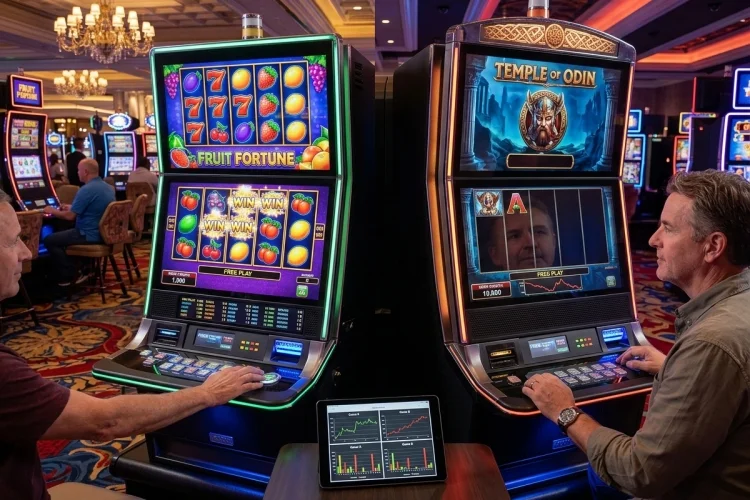

A surprisingly good run in a slot demo can create suspicion when the real-money version later behaves very differently. The natural explanation seems obvious: perhaps the free game was designed to win more often.
In a properly regulated environment, that is not how a corresponding public Demo Slot is supposed to work.
Randomness means the exact outcomes of two sessions can be completely different. What certification and technical standards are concerned with is the mathematical structure behind those outcomes. Game rules, probabilities, payout distribution, RNG behaviour, and advertised RTP should correspond with the version being offered.
Great Britain’s Gambling Commission requires free-play games offered alongside paid games to represent their real-money counterparts accurately. Malta’s regulator goes further in particularly simple terms by requiring the demo RTP percentage to match the real-money game.
Random Results and Different Mathematics Are Not the Same Thing
There are two very different meanings of “different outcomes.”
The first is perfectly normal randomness.
Suppose the same slot is played in two independent sessions. One produces a bonus after 40 spins and the other does not trigger it for hundreds.
That can happen even when both sessions use the same mathematical probabilities.
The second type of difference is systematic.
Imagine the demo feature has been configured so that the bonus probability is intentionally doubled.
Now the free version no longer represents the same statistical experience.
UK Gambling Commission RTS 6 specifically aims to minimise this risk. It requires the same game rules and reasonable steps to ensure that free-play probabilities and prize distribution accurately represent the corresponding paid version.
That distinction is the foundation of the certification discussion.
Certification Starts With the Game Mathematics
A slot is not certified simply because its graphics load correctly.
Behind the interface sits a mathematical specification describing how random inputs map into game outcomes, how much each result pays, and the theoretical return generated across the complete probability model.
In Great Britain, the testing process must be sufficient to assess compliance with the Remote Gambling and Software Technical Standards. Approved test houses conduct relevant third-party testing.
The Commission stated in 2026 that independent testing includes verifying that the advertised RTP is correct and that the game follows the rules presented to customers.
So a certfication review deals with both maths and implementation.
A beautifully written paytable is useless if the software underneath behaves differently.
Likewise, mathematically correct code is not enough if the information provided to players describes another configuration.
RNG Testing Looks Behind the Visible Reels
The animation on screen is generally the presentation layer.
Testing needs to examine the random process driving outcomes behind it.
The Gambling Commission’s procedure includes reviewing RNG documentation and source code, checking the algorithm for known weaknesses, and statistically testing its raw, scaled, or shuffled output.
This is important because merely watching thousands of animated reel spins would be an inefficient way to assess randomness.
Laboratory testing works closer to the source.
The goal is not to make every result unpredictable to the test house itself; it is to verify that the implementation produces outcomes according to the intended random process and mathematical mapping.
The Commission requires game and RNG test reports from applicable remote licensees and says satisfactory testing must be completed before release.
That provides a structured verificaton process beyond visual observation.
Why Demo and Real Spins Will Never “Match”
Imagine a certified slot with a 1-in-100 illustrative probability of triggering a particular event.
If you run 100 demo spins, you are not guaranteed to see the event exactly once.
You might see it zero times.
You might see it three times.
A second 100-spin real-money sample could produce another completely different count.
Random probability describes the long-run behaviour of possible outcomes, not a timetable.
That is why comparing a personal demo session with a paid session can create misleading conclusions.
Great Britain’s rules focus on accurate likelihood and prize distribution rather than requiring matching sequences. The implementation guidance even allows an appropriate alternative RNG for free play provided it does not introduce systematic bias and accurately represents game probabilities.
The two versions therefore need mathematical equivalence, not synchronized spins.
Prize Frequency Can Matter as Much as RTP
Imagine two games with a theoretical 96% return.
The first generates small prizes frequently.
The second has fewer wins but occasional very large outcomes.
Their theoretical RTP could theoretically match even though their player-facing behaviour feels very different.
This is why Great Britain’s free-play standard does not talk about RTP alone. It explicitly addresses likelihood of winning and prize distribution.
For virtual-money demos, its guidance says payouts should correspond with those in the play-for-money version.
Malta additionally requires the same RTP percentage for demo and real-money configurations.
Taken together, these principles help prevent a demo from simply generating more frequent exciting events while technically maintaining some other mathematical similarity.
Representative play involves the shape of the distribution, not just one average number.
Game Rules Provide Another Certification Check
Players usually cannot inspect RNG source code.
They can inspect the rules.
Great Britain’s RTS 3 requires accessible information explaining how the game operates, how winning outcomes are determined, how prizes are allocated, and information such as RTP, house edge, or winning probabilities where applicable.
That information creates a useful public reference point.
Suppose the real version states:
RTP: 96.2%
but the corresponding operator demo states:
RTP: 97.5%
That deserves attention because the two configurations are clearly not being described as mathematically identical.
Likewise, differences in feature rules, prize amounts, or bonus conditions might reveal that you are not actually comparing the same version.
Checking the rules is more reliable than deciding based on whether one session “felt luckier.”
That subjective differnce can occur naturally.
Internal Demonstrations Are a Special Case
Not every free slot shown online should automatically be interpreted as a consumer-facing replica of a live product.
Developers and suppliers can maintain internal or promotional environments designed to demonstrate features.
UK guidance recognises this possibility. When a supplier site demonstrates a game with higher-than-normal returns specifically to showcase bonus features, consumers should be told that the demonstration has been designed for that purpose.
GLI-11 also distinguishes player free-play from test/diagnostic modes. Its standard says free-play games should accurately represent normal paid operation, while diagnostic modes can be used to inspect mechanics and conduct technical tests.
The label therefore matters.
A QA build with forced bonuses is not necessarily intended to represent real-world probabilities.
A public regulated demo offered as the counterpart of a money game is a different situation.
Certification Is Jurisdiction-Specific
It is tempting to talk about “slot certification” as though every country uses one global rulebook.
They do not.
Great Britain has its own RTS and approved test-house framework. Malta has its own licensing and player-protection requirements. GLI publishes technical standards that many jurisdictions use as references, but individual regulators ultimately define their own legal requirements.
This means a claim such as “all demos everywhere must work exactly like this” would be too broad.
The more accurate question is:
Which regulator covers the operator, and what does that jurisdiction require?
For Great Britain, matching game rules and representative probabilities are explicit requirements.
For Malta-regulated operators, matching demo and real-money RTP is explicitly stated by the MGA.
Understanding that jurisdictional context makes certification claims much easier to evaluate.
How to Compare Demo and Real Play Properly
Start with the exact game version rather than the title alone.
Compare the RTP displayed in both versions, especially because some providers offer multiple mathematical configurations of one title.
Next, inspect the paytable, maximum payout, feature rules, and bonus conditions.
Confirm that you are using a public free-play game rather than a supplier feature demonstration or internal testing build.
Most importantly, do not judge mathematical consistancy from 50 or 100 spins.
Certification works through technical examination and statistical testing because random games naturally produce uneven short-term samples.
A lucky demo session and an unlucky real session can coexist perfectly well within the same probability model.
The existence of that contrast is not evidence of manipulation.
A certified Demo Slot does not need to reproduce the exact outcomes of real-money play. Random sessions naturally differ. What matters is whether the free version accurately represents the relevant rules, probabilities, RTP, and prize distribution under its jurisdiction’s requirements.
Check the game information and licence context first, and treat short demo-versus-real comparisons as anecdotes rather than statistical tests.