Skip to content

Recent Posts

  • Mythology Slots and the Lasting Power of Ancient Game Worlds
  • Norse Mythology Slots: Gods, Runes, and Bonus Rounds Explained
  • Compare Slots Better: Volatility, Hit Rate and Payout Distribution
  • Classic Fruit Slots: Why Simple Reels Still Feel Fresh
  • NetEnt Slots: From Classic Hits to Modern Features

Most Used Categories

  • Free Slots (5)
  • Slot Themes (4)
  • Megaways Slots (4)
  • Slot Guides (3)
  • Mobile Slots (3)
  • Slot Features (3)
  • Slot Providers (2)
  • Jackpot Slots (2)
  • High-RTP Slots (2)
  • Slot Reviews (2)
Skip to content
Synergie Solutions Web

Synergie Solutions Web

Subscribe
  • Jackpot Slots
  • Megaways Slots
  • Mobile Slots
  • Slot Features
  • Slot Providers
  • Slot Guides

Home › Slot Themes

Category: Slot Themes

Mythology Slots and the Lasting Power of Ancient Game Worlds

Mythology Slots and the Lasting Power of Ancient Game Worlds

Elena Morales09/01/202608/13/2026

Why do game lobbies keep returning to Olympus, Egyptian tombs, Norse gods, and legendary heroes when developers could invent completely new worlds?

The answer is not simply nostalgia.

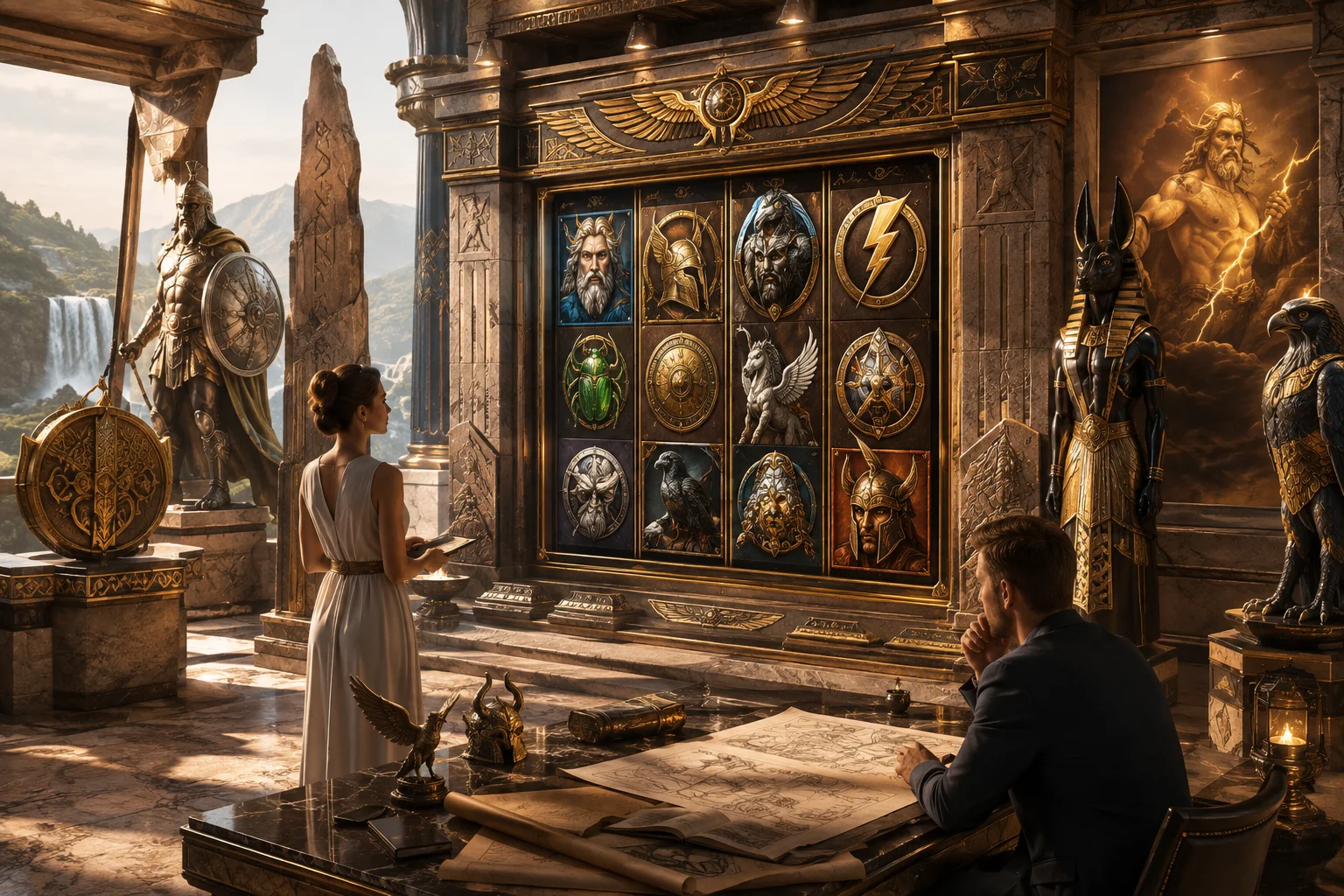
Mythology Slots give designers a rare combination of familiarity and freedom. Ancient stories come with memorable characters, powerful symbols, dramatic locations, supernatural abilities, and conflicts that can be translated directly into modern game mechanics. At the same time, mythology is flexible enough to be retold in serious, colourful, comedic, futuristic, or highly stylised ways.

The wider games industry has also repeatedly adapted ancient Greece, Rome, Egypt, and other mythological traditions. Academic work on classical reception now treats video games as an important part of how modern audiences encounter and reinterpret the ancient world.

That makes mythology unusually suited to continual reinvention.

Ancient Myths Already Contain Game-Like Structures

Many myths naturally resemble game scenarios.

A hero receives a task.

They travel into dangerous territory.

They face monsters.

They collect powerful objects.

They confront a final enemy.

Hercules and his famous trials are an obvious example.

Play’n GO has continued using Hercules in modern slot design, including 13th Trial Hercules Abyssways, where mythological obstacles and characters are integrated into changing gameplay states.

The story already provides progression.

A designer does not need to invent why the hero is fighting monsters or entering another realm.

That makes mythology a natural foundation for bonus rounds, collection mechanics, expanding grids, transformations, and staged features.

Mechanics can feel like chapters of the myth rather than unrelated effects.

Mythological Powers Translate Easily Into Mechanics

Ancient gods conveniently have very clear abilities.

That is almost perfect for feature design.

Zeus controls lightning.

Poseidon controls the sea.

Hades rules the underworld.

Thor has his hammer.

Anubis is strongly associated with death and the afterlife.

These characteristics can become wild transformations, multipliers, respins, symbol destruction, or bonus triggers.

Pragmatic Play’s Gates of Olympus connects Zeus with random multiplier symbols during tumbling sequences, while Zeus vs Hades – Gods of War uses the rivalry between two gods to frame different game modes.

This is efficient visual communication.

If lightning strikes the grid and increases a multiplier, the event feels thematically logical.

Compare that with an unrelated theme where a multiplier appears for no narrative reason.

The numbers may be identical.

The first design simply has stronger thematic context.

Ancient Settings Provide Strong Visual Identity

Slot games need to establish atmosphere quickly.

Mythology offers ready-made architectural and visual languages.

Greek themes can use temples, marble statues, mountains, lightning, armour, laurel leaves, and gold.

Egyptian themes can use deserts, tombs, pyramids, scarabs, pharaohs, hieroglyphics, and funerary imagery.

Play’n GO’s Book of Dead is a clear example of how Ancient Egypt can support an entire visual world built around tomb exploration and the afterlife.

The setting also creates natural locations for bonuses.

A temple door can open into Free Spins.

A tomb can reveal a mystery symbol.

An underworld scene can signal a higher-volatility mode.

A mountain peak can introduce a god character.

The enviroment becomes part of feature communication.

Familiar Stories Lower the World-Building Barrier

Inventing a completely original fantasy universe requires explanation.

Who is the king?

Why is the villain dangerous?

What is the magical object?

Why should anyone care about the temple?

Mythology can skip much of that setup.

Many audiences already have at least some awareness of Zeus, Hercules, Medusa, pyramids, Vikings, or Egyptian gods through films, books, games, school, and popular culture.

Research on classical reception demonstrates how ancient material has repeatedly circulated through later cultural forms, while scholarship on games increasingly studies interactive adaptations as part of that ongoing process.

This does not mean every player knows the original myths accurately.

They do not need to.

A rough cultural association can be enough.

Lightning god.

Ancient tomb.

Hero versus monster.

Those concepts are immediately usable.

That saves valuable screen time and reduces the amount of explenation required.

Mythology Can Support Very Different Mathematical Profiles

A mythological theme does not lock a developer into one kind of slot.

The same Zeus character can support completely different mathematical systems.

For example, Pragmatic Play’s Zeus vs Hades – Gods of War offers a choice between Olympus and Hades. Olympus has a higher probability of reaching the bonus but a lower average bonus win, while Hades triggers the feature less frequently but offers a higher average win when it occurs.

The mythological opposition becomes a way to present volatility differences.

Another Zeus game might focus on cluster pays.

Another could use paylines.

Another can revolve around multipliers.

This flexibility is important commercially and creatively.

Developers can keep a recognisable theme while rebuilding the underlying mechanics.

That makes mythology particularly suitable for sequels and related titles.

Ancient Themes Work Well With Series and Franchises

A strong mythological character can be reused without feeling completely out of place.

Pragmatic Play has expanded the Olympus concept through titles such as Gates of Olympus, Gates of Olympus 1000, Gates of Olympus Super Scatter, and Fortune of Olympus.

Play’n GO has also repeatedly revisited Greek mythology, publishing collections that include Zeus, Hades, Poseidon, Hercules, and other ancient figures.

This demonstrates another design advantage.

Mythology acts almost like a shared narrative toolbox.

A sequel can change the mechanics without abandoning the world.

A designer can introduce a different god.

A spin-off can focus on one legendary object.

A new game can reinterpret an existing conflict.

The cultural source material is broad enough to keep producing variations.

Mythological Worlds Can Mix Familiarity With Novelty

The biggest danger with ancient themes is repetition.

Another golden temple and another Zeus character can quickly look like something players have already seen.

The solution is not necessarily abandoning mythology.

It is interpreting it differently.

Play’n GO’s Pandora’s Box of Evil, for example, takes the familiar Pandora story and builds its own stylised version around hope, magic, and monsters.

Its 13th Trial Hercules Abyssways similarly reworks Hercules through a distinctive visual identity and newer mechanics rather than simply repeating a generic ancient-temple template.

This is where good art direction becomes essential.

The myth supplies familiarity.

The designer supplies novelty.

Without that second part, the theme can feel formulaic.

Mythology Also Works Across Different Cultures

Greek mythology may be especially common, but ancient-theme design is much broader.

Egyptian, Norse, Roman, Chinese, Mesoamerican, Indian, Japanese, and other traditions provide different characters, architecture, legends, and symbolic systems.

This creates enormous creative possibilities.

It also creates responsibility.

Ancient cultures should not be treated as interchangeable collections of exotic symbols.

Academic research into historical and mythological representation in games increasingly examines authenticity, cultural interpretation, and the ways ancient material is reconstructed for modern audiences.

Developers do not have to create museum exhibits.

A fantasy slot can be exaggerated and imaginative.

But stronger research usually creates a richer world and avoids lazy combinations.

That becomes especially relavent when games are distributed internationally.

Mythology Creates Strong Mechanic-Theme Alignment

The most successful ancient-themed games tend to connect what the feature does with what the mythology suggests it should do.

A thunder god creates multipliers.

A sea god floods reels.

A phoenix might respawn.

A legendary book reveals hidden symbols.

A monster destroys positions.

A hero progresses through trials.

This is stronger than simply placing mythological artwork around a generic slot engine.

Play’n GO’s own mythology-focused releases frequently connect characters and story events with specific features, while Pragmatic Play’s Zeus-based titles similarly use lightning, gods, Olympus, and multipliers as parts of one visual-mechanical language.

When theme and mechanic support each other, the rules become easier to remember.

That is one of mythology’s biggest design advantages.

The ancient story does not just decorate the feature.

It helps explain it.

Mythology Slots continue to work because ancient worlds offer game designers ready-made heroes, villains, symbols, conflicts, and supernatural powers. They support everything from multipliers to evolving bonus rounds while remaining flexible enough for sequels and reinterpretations.

The strongest modern designs keep the familiar mythology but introduce fresh mechanics, art direction, and cultural detail so the theme feels renewed rather than recycled.
Norse Mythology Slots: Gods, Runes, and Bonus Rounds Explained

Norse Mythology Slots: Gods, Runes, and Bonus Rounds Explained

Elena Morales08/27/202608/05/2026

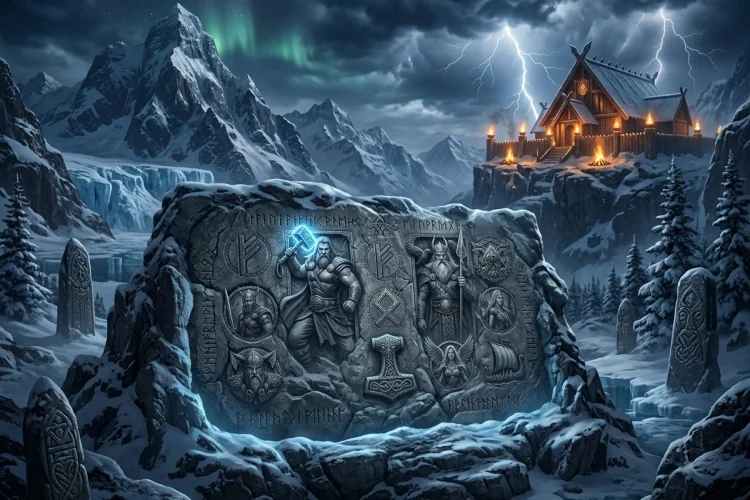
Thunderstorms, frozen mountains, glowing runes, and legendary gods give Norse-themed games an instantly dramatic look.

Even before the first spin, characters such as Thor and Odin suggest battles, supernatural powers, and enormous halls filled with Viking warriors. The appeal of Norse Mythology Slots goes beyond strong artwork.

Developers can turn famous gods into wild symbols, use magical-looking runes as matching icons, and build bonus rounds around Asgard, Valhalla, or Ragnarök.

Although the games are entertainment rather than history lessons, understanding the common characters and symbols makes their features easier to follow. It also helps separate genuine Norse references from creative fantasy added by the developer.

Odin Often Represents Wisdom and Power

Odin is commonly presented as the ruler or senior figure among the gods. Historical knowledge of Odin, Thor, Freya, and other Norse deities comes largely from medieval sources such as the Eddas and Icelandic sagas, supported by archaeological evidence and place names.

In slot games, Odin may appear as a high-value character, wild symbol, symbol transformer, or controller of a special feature. His ravens, spear, and one-eyed appearance make him easy to recognize.

Viking Runecraft places Odin beside Thor, Freya, and Heimdall as one of four gods whose special powers can influence its grid.

Thor Brings Lightning and Wild Symbols

Thor is usually connected with thunder, strength, and his famous hammer. Developers often translate those ideas into lightning strikes that remove symbols, add wilds, or activate multipliers.

In Viking Runecraft: Apocalypse, Thor’s Gift of the Gods power adds between six and ten wild symbols to the grid. Odin, Freya, and Heimdall provide different wild patterns, giving each character a distinct function.

Thor can also become a moving character. In Tales of Asgard: Freya’s Wedding, he appears as a stacked wild on the fifth reel and moves one position to the left during each free spin.

Freya Supports Multiple Bonus Styles

Freya is regularly associated with love, war, fertility, and supernatural power. That broad identity gives designers several directions for bonus mechanics.

The Faces of Freya uses four levels of free-spin progression. These modes upgrade symbols, add random wilds, increase multipliers, or combine several benefits in the final Folkvang feature.

Her features are generally more layered than a simple expanding wild. The player may need to collect scatters or move through different levels before the strongest version becomes active.

Loki Adds Mystery and Disruption

Loki is an ideal character for unpredictable features. He is often shown changing symbols, creating mystery icons, or interrupting an otherwise normal round.

Tales of Asgard: Loki’s Fortune uses mystery symbols and dynamic payways that can expand from 3,125 to as many as 100,000. Loki serves as a wild, while Odin and Thor also appear within the family-conflict storyline.

This type of mechanic matches Loki’s mischievous personality without requiring the game to retell a complete myth.

Runes Are Common Reel Symbols

Runes were writing symbols rather than decorative magical signs. The Viking Ship Museum explains that they worked phonetically, much like letters, with individual rune names beginning with the sound they represented.

Viking rune stones were often created to commemorate important people and their deeds. Most surviving inscriptions are practical or memorial, although Norse sagas also connect some runes with protection, prophecy, curses, and magic.

Games simplify this history by using brightly colored runes as ordinary symbols, multipliers, collectors, or feature triggers.

Ragnarök Creates a Natural Final Bonus

Ragnarök, the destructive conflict associated with the end and renewal of the mythological world, gives designers an obvious setting for a major bonus round.

Viking Runecraft uses its god characters and grid progression to build toward a battle against destructive forces. Viking Runecraft: Apocalypse continues the idea with Spirit Wild collection, Gifts of the Gods, Loki’s Mischief, and Ragnarök Free Spins.

The theme makes a final or upgraded feature feel like the conclusion of a battle rather than a disconnected set of free rounds.

Norse Mythology Slots use Odin, Thor, Freya, Loki, Heimdall, runes, wolves, ravens, and legendary locations to create visually powerful games.

These elements commonly become wild symbols, mystery icons, multipliers, character powers, and free-spin features.

The historical references are often simplified or mixed with fantasy, so familiar artwork does not guarantee familiar rules. Open the paytable and check exactly what each god or rune does before playing.

Try several free demos and compare how effectively the mechanics match the mythology. The strongest designs make their symbols readable and their bonus progression easy to understand.

Classic Fruit Slots: Why Simple Reels Still Feel Fresh

Classic Fruit Slots: Why Simple Reels Still Feel Fresh

Elena Morales08/22/202608/05/2026

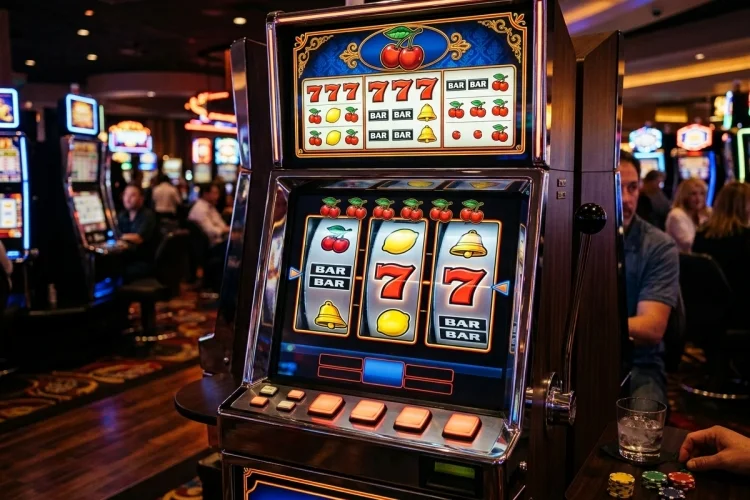
Online slots can now include animated characters, expanding grids, cinematic stories, and complicated bonus systems. Yet games filled with cherries, lemons, bells, bars, and lucky sevens continue to appear in casino libraries.

The lasting popularity of Classic Fruit Slots comes from a combination of familiarity and simplicity. Players can usually understand the basic layout within seconds, while developers can update the traditional formula with wild reels, multipliers, free spins, and modern graphics.

These games connect the mechanical past of slot machines with today’s browser and mobile technology, giving them a style that feels nostalgic without necessarily feeling outdated.

Fruit Symbols Have a Long History

Early mechanical slot machines used symbols such as bells, horseshoes, and playing-card suits.

Later machines were presented as gum dispensers, with fruit images representing different gum flavors. This association helped establish cherries, lemons, oranges, and plums as standard reel symbols.

The familiar BAR icon also has historical connections to the Bell-Fruit Gum branding used on early machines. Over time, these symbols became part of the visual language of slot gaming, even after the original gum connection disappeared.

The Rules Are Usually Easy to Understand

Many fruit games use a compact reel layout and a limited number of paylines. Players generally look for matching symbols from left to right, without needing to follow a long story or learn several feature meters.

NOVOMATIC’s Sizzling Hot deluxe, for example, uses five reels and five fixed lines. Its official page describes it as a video-game classic built around the familiar Sizzling Hot formula.

Simple rules do not mean that every fruit game is identical. The number of lines, volatility, wild behavior, and maximum payout can still vary significantly.

Familiar Symbols Improve Readability

Fruit icons usually have clear shapes and contrasting colors. A cherry looks different from a watermelon, while a bell, seven, or BAR symbol is easy to identify at a glance.

This clarity is particularly useful on a mobile phone. Detailed character artwork may become difficult to recognize on a small screen, but simple fruit symbols often remain readable in portrait or landscape mode.

The result is an interface that can feel quick and uncluttered, even when the game includes several paylines.

Nostalgia Appeals to Different Generations

Older players may associate fruit symbols with physical casino machines, arcades, pubs, or amusement venues. Newer players may simply recognize the style as a familiar part of popular culture.

That nostalgic design can make a game feel approachable. It does not require knowledge of mythology, films, fantasy worlds, or complicated fictional characters.

Play’n GO’s Fire Joker demonstrates this retro approach with three reels, fruit symbols, a wild Joker, a respin feature, and a multiplier wheel that can increase a qualifying win up to ten times.

Modern Features Keep the Formula Alive

Developers regularly add new mechanics without removing the recognizable fruit-machine identity. Wild reels, free spins, expanding symbols, multipliers, jackpots, and variable reel structures can all appear behind traditional artwork.

NetEnt’s Fruit Shop uses a 5×3 format, 15 paylines, wild substitutions, and a multiplier system. Its official specifications list a 96.71% RTP and an 800x maximum payout.

Pragmatic Play’s Fire Hot 40 also takes inspiration from traditional fruit machines but adds growing wild symbols that can cover entire reels. Its listed RTP is 96.43%.

Fruit Slots Can Suit Short Demo Sessions

Because the rules are usually visible and understandable, a player can evaluate a fruit slot quickly. A short demo can reveal whether the controls are readable, the animation is smooth, and the feature explanations are clear.

Demo results should not be used to predict future payouts. Virtual credits are useful for examining design and mechanics, but a large practice win does not make the game more predictable.

The practical advantage is convenience: players can compare several games without spending a long time learning each interface.

Simple Artwork Does Not Mean Better Odds

Fruit symbols affect presentation, not probability. A traditional-looking game can have a different RTP, volatility level, stake range, and maximum win from another title using almost identical symbols.

Always open the paytable and information menu before playing. Check how wins form, whether paylines are fixed, and what any wild or bonus symbol actually does.

The game’s mathematical profile matters more than whether the reels display cherries or fictional warriors.

Classic Fruit Slots remain popular because they combine historical familiarity with easy-to-read gameplay.

Their cherries, lemons, bells, and sevens are instantly recognizable, while compact layouts make the rules approachable for beginners.

Modern versions keep the style relevant by adding wild reels, multipliers, free spins, jackpots, and alternative reel systems. Theme alone does not determine RTP or winning chances, so every title should still be checked individually.

Open a trusted free demo, read the paytable, and compare several fruit games to see whether you prefer a simple retro format or a modern version with additional features.

Theme-Mechanic Design: Making Modern Online Slot Features Feel Natural

Theme-Mechanic Design: Making Modern Online Slot Features Feel Natural

Elena Morales08/05/202608/13/2026

The easiest slot mechanics to understand are often the ones that do not feel like mechanics at all. A buffalo stampede fills the reels with wilds. A treasure hunt increases a reward meter. A dance-floor game becomes more energetic as winning symbols disappear and the playing area expands.

These are examples of Theme-Mechanic design working properly.

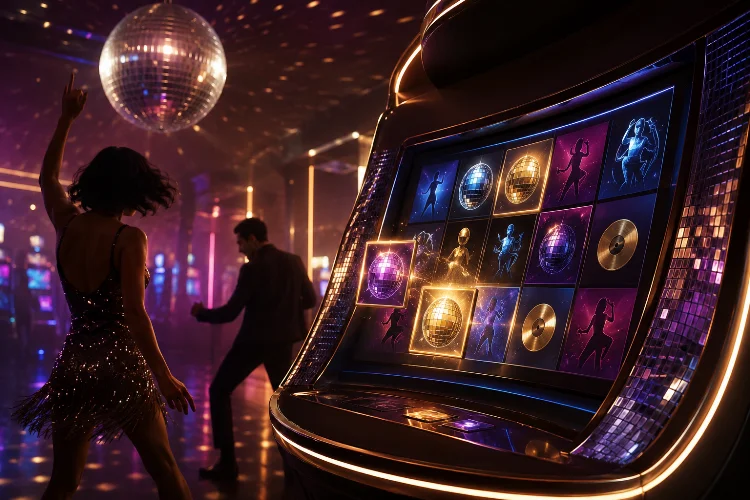
A Modern Online Slot may contain complex probability systems underneath the interface, but players experience those systems through characters, environments, animation, and sound. Funk Master, for example, connects its disco identity with Dancing Wilds, Cluster Pays, Avalanches, and an expanding play area during Free Spins.

The mathematics still matters most for determining outcomes. Yet the theme can determine whether those outcomes feel coherent, memorable, and easy to follow.

Theme Can Define the Rhythm of Gameplay

Not every slot should move at the same pace.

A classic fruit-machine theme often works with direct interactions. Spin, evaluate, pay, repeat.

A cinematic adventure game can support a slower progression structure where several events gradually lead toward a larger feature.

Theme therefore influences the perceived rhythm of gameplay.

Imagine an underwater treasure game.

Collecting keys over several events can feel natural because searching and discovery are already part of the fictional setting. The same collection system inside a minimalist fruit slot could feel unnecessarily complicated.

Ocean’s Treasure uses an Atlantis-inspired environment alongside Stacked Wilds and Free Spins with an increasing level multiplier. Evolution also describes it as a high-volatility game with the possibility of substantial additional Free Spins.

The underwater exploration theme helps progression feel deliberate rather than arbitrary.

Visual Events Can Represent Changes in Mathematical State

Modern slots frequently switch between different game states.

The base game might use ordinary rules. A bonus can introduce extra wilds. Later stages may increase multipliers or change reel dimensions.

Players do not need to think of these technically as state transitions.

Theme can make those transitions visible.

For example, the screen might move from a quiet village into a dragon’s lair. The reels expand, the soundtrack changes, and wilds begin locking into place.

The visuals tell the player that a different ruleset is now active.

This is one reason Theme-Mechanic design is valuable. It turns an abstract mathematical transition into something that can be recognised immediately.

Good thematic signalling reduces the amount of explenation needed without removing the need for clear game rules.

Feature Names Should Describe What Players Actually See

Feature naming is another small but important part of alignment.

A mechanic called “Buffalo Stampede” makes sense if buffalo-related Wilds actually rush onto the grid.

Buffalo Mania Megaways does precisely this. Its Buffalo Stampede feature can place multiple Buffalo Wilds on the reels, while Super Wilds can cover whole reels and interact with Ways Multipliers.

That creates a direct connection between name, animation, and function.

Imagine instead that Buffalo Stampede simply added an invisible 2% modifier somewhere in the background.

The name would have little relationship with the player’s experience.

Strong feature naming gives players clues about what is occurring.

It does not have to explain the exact probability, but the fictional event and mechanical event should point in the same direction.

Theme Can Make Wild Behaviour Easier to Understand

Wild symbols have become increasingly complicated.

A basic Wild substitutes for another symbol. Modern games may include expanding Wilds, moving Wilds, multiplier Wilds, sticky Wilds, or Wilds that transform nearby symbols.

Without visual logic, these differences can become confusing.

Theme helps make them intuitive.

Funk Master’s Dancing Wild fits its disco setting while participating in winning clusters and interacting with the Avalanche mechanic.

A military-themed game could represent a moving Wild as a vehicle advancing across the grid. An exploration slot could use a torch that reveals additional positions.

The underlying rules might be similar, but the theme gives each version a distinct identity.

This makes the mechanic easier to remember because behaviour and presentation reinforce one another.

Reward Hierarchy Can Follow the Story

Slot games need to communicate which events are ordinary and which are important.

Theme can build that hierarchy.

Basic symbols might represent common objects from the fictional world. Premium symbols can represent important characters. Scatters might represent a destination, while the highest feature state represents completion of the story.

This hierarchy becomes especially useful in games containing several progression levels.

Space Wars 2 Powerpoints uses collected Powerpoints to feed a multiplier system and determine Free Spins awards at different thresholds.

The science-fiction idea of building energy gives meaning to increasing numerical values.

Without that concept, players would simply see a meter increasing from one arbitrary number to another.

Theme creates contexual meaning around progression.

The same mathematics can become much easier to understand when every level represents something familiar inside the game world.

Theme Can Affect How Volatility Feels

Theme does not determine mathematical volatility, but presentation can influence how players experience quieter periods.

Consider a highly volatile game where major wins and bonus states are relatively uncommon.

If nothing happens between those events, the game may feel static.

A well-integrated theme can create visual progression, collections, environmental changes, or character responses without necessarily increasing the probability of winning.

This distinction is important.

A progress animation may provide entertainment without having any mathematical effect unless the rules say otherwise.

GLI’s RTP analysis treats volatility and contributions from feature games as mathematical characteristics that can be evaluated independently from the visual theme.

So an active-looking game is not automatically a frequently paying game.

Theme can change the feel of pacing without secretly changing the numbers underneath.

Mechanics Should Support the Fantasy, Not Fight It

Theme-Mechanic alignment is easiest to notice when it goes wrong.

Imagine a calm gardening slot where every win launches explosions, missiles, and collapsing buildings.

The feature might be technically impressive, but it conflicts with the fictional experience.

Now imagine plants growing after successful combinations, larger flowers becoming Wilds, and completing a garden unlocking Free Spins.

The same concepts—expansion, transformation, and progression—fit much more naturally.

This is why developers often select mechanics according to thematic verbs.

Adventure suggests exploring and discovering. Mining suggests digging and exploding. Music suggests rhythm and building energy. Fishing suggests collecting and catching.

These associations give designers a useful framework for selecting features.

The result can feel more intentional than taking a generic feature package and applying new artwork.

Good Alignment Also Improves Mobile UX

Theme-Mechanic design matters even more on a mobile screen.

There is less space for explanatory panels, large paytables, and persistent instructions.

Visual communication therefore becomes important.

If a multiplier is represented as a clearly growing rocket, players can understand its progression without dedicating a large section of the screen to text.

Space Wars 2 Powerpoints uses a multiplier rocket powered by collected Powerpoints, creating a visually direct link between collection and increasing reward potential.

This kind of interface can reduce clutter.

However, accessibility and clarity still matter. A thematic icon should not be the only way important rules are communicated.

The UK Gambling Commission requires relevant rules and information about how games work and the likelihood of winning to be made available to customers.

Theme should simplify interaction, not turn essential rules into a guessing game.

Mathematical Integrity Still Comes First

A beautifully aligned game still needs a valid mathematical model.

The theme cannot decide that an outcome becomes more likely because it would make the story more dramatic.

RNG-driven outcomes must follow the applicable probability model. UK technical standards require results to be acceptably random and prohibit adaptive behaviour that adjusts winning likelihood according to previous payouts or intake.

GLI likewise tests RNG systems for unpredictability and potential bias.

So if a game shows a monster becoming angrier after several losing spins, that animation should not be interpreted as evidence that a win is becoming mathematically “due” unless an explicitly defined feature genuinely changes the state.

Theme can visualise a real mechanic.

It should not invent a false relationship between presentation and probability.

This separation is fundamental to consistant game design.

Good Theme-Mechanic alignment helps a Modern Online Slot communicate complicated features through intuitive events, characters, progression, and environments. It can shape pacing, wild behaviour, reward hierarchy, and mobile UX while leaving probability calculations to the mathematical model.

The strongest designs make mechanics feel like a natural part of the world. When theme and gameplay tell the same story, complexity becomes much easier to understand.

Recommended

  • Wild Symbol Weighting: Why More Wilds Do Not Always Mean More WinsWild Symbol Weighting: Why More Wilds Do Not Always Mean More Wins
  • Can Free Spins Be Retriggered? How Extra Spins WorkCan Free Spins Be Retriggered? How Extra Spins Work
  • What Is a Free Spins Bonus Round? A Simple Slot GuideWhat Is a Free Spins Bonus Round? A Simple Slot Guide
  • Does a Higher RTP Mean You Will Win More? The Real AnswerDoes a Higher RTP Mean You Will Win More? The Real Answer
Build stronger financial knowledge with practical insights into personal finance, investing, saving, budgeting, markets, business, and long term planning. Our financial content explains important concepts clearly while exploring strategies, trends, and economic developments that can help readers make more informed decisions, manage money responsibly, and understand changing financial opportunities responsibly.
Click Here
Visit Our Site
Learn More
Read More
Find Out More
Discover More
Explore More
See More
View More
Get Started
Start Here
Visit Now
Click to Learn More
Explore Now
Discover Now
Check It Out
Take a Look
View Details
See Details
Learn More Here
Find Out Here
Discover It Here
Explore Our Site
Visit the Website
Go to Website
Visit This Page
Open Website
Browse Our Site
Browse Now
Explore the Website
Find More Information
Get More Information
Read the Full Story
Read Full Details
View Full Details
See Full Information
Discover the Details
Explore the Details
Learn the Details
Check the Details
Continue Reading
Keep Reading
Read Further
Explore Further
Discover Further
Learn More Today
Explore Today
Discover Today
Visit Today
Check It Out Now
See What’s Inside
Discover What’s Inside
Explore What’s Inside
See What We Offer
Discover What We Offer
Explore Our Options
View Our Options
See Your Options
Explore Your Options
Discover Your Options

What’s New

  • Mythology Slots and the Lasting Power of Ancient Game WorldsMythology Slots and the Lasting Power of Ancient Game Worlds
  • Norse Mythology Slots: Gods, Runes, and Bonus Rounds ExplainedNorse Mythology Slots: Gods, Runes, and Bonus Rounds Explained
  • Compare Slots Better: Volatility, Hit Rate and Payout DistributionCompare Slots Better: Volatility, Hit Rate and Payout Distribution
  • Classic Fruit Slots: Why Simple Reels Still Feel FreshClassic Fruit Slots: Why Simple Reels Still Feel Fresh
  • About Us
  • Contact
  • Disclaimer
  • Privacy Policy
  • Terms & Conditions
  • Sitemap
© 2026 Synergie Solutions | Theme: BlockWP by Candid Themes.