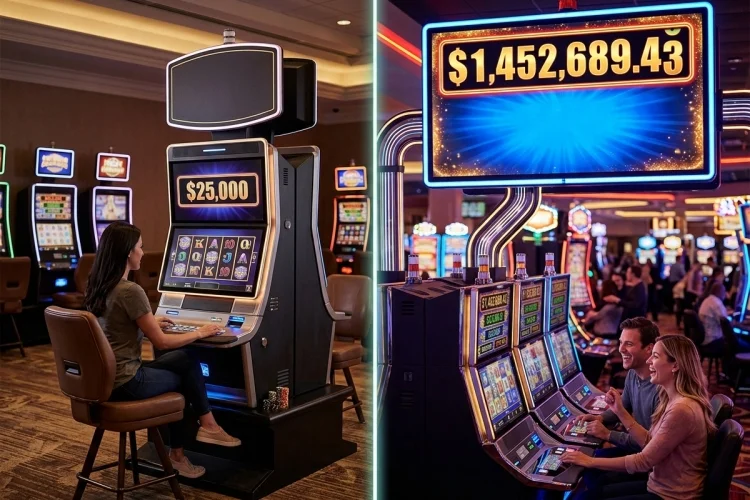

A classic fruit machine and a modern 6×5 video slot may both use the same basic idea – place a bet, spin, and let random outcomes determine the result – but almost everything surrounding that process can be different.
The New Slots vs Classic Slots comparison becomes more interesting once you look beyond graphics. Modern games can use tumbling reels, thousands of ways to win, enormous multipliers, and feature-buy systems.
Older designs generally keep the mathematics visible through fixed paylines and simpler symbols. Neither approach is automatically superior, so understanding the trade-offs makes choosing a game much easier.
Classic Slots Keep the Core Mechanic Visible
Classic slot design tends to place the reels at the center of everything.
You usually see three or five reels, a limited number of paylines, and easily recognizable symbols. Wins are typically formed by matching symbols along those lines.
NetEnt’s Mega Joker is an obvious example. It uses only three reels and five fixed paylines, though its Supermeter system adds some extra depth.
The important advantage is transparency of presentation.
You can glance at the reels and usually understand what happened.
Modern games often hide more mathematical complexity behind animations and features.
A winning spin may trigger a tumble, which activates a multiplier, which produces another tumble, which increases a bonus meter.
That can be entertaining, but it creates a longer chain between the original spin and final result.
Modern Win Systems Go Beyond Paylines
One of the biggest differences is how winning combinations are constructed.
Classic games generally use fixed paylines.
New releases may use Megaways, cluster pays, pay-anywhere systems, adjacent-reel wins, or dynamically expanding grids.
Twin Spin Megaways, for example, can create up to 117,649 ways to win because each reel can display between two and seven symbols.
Meanwhile, Gates of Olympus 1000 does not rely on traditional paylines at all. Eight or more identical symbols can create a win anywhere on its 6×5 grid.
These systems are more flexible than traditional lines, but flexibility does not mean better odds.
They simply represent different methods for defining successful combinations.
Always read the paytable instead of assuming that “more ways to win” automatically means more profitable gameplay.
New Slots Put More Emphasis on Feature Progression
Classic bonus mechanics are often simple.
A Wild might substitute for other symbols, three Scatters may trigger Free Spins, or a jackpot may activate under specific conditions.
Newer games increasingly treat bonus features like mini progression systems.
Big Bass Bonanza 1000, for example, allows Wilds to collect Money symbols during Free Spins. Every fourth Wild adds ten extra spins and increases the collection multiplier, eventually reaching x10.
That gives the feature stages.
Instead of merely entering Free Spins, the player can potentially progress through several levels during the same bonus.
This design can create more suspense, but it also makes understanding average feature value more complicated.
A feature that can reach a large multiplier may often end before reaching its strongest stage.
Maximum capability should therefore never be confused with a normal bonus result.
Maximum Wins Have Become Much More Visible
Older slots often advertise relatively modest maximum payouts.
NetEnt currently lists Starburst, released in 2012, with an 800x maximum payout.
By comparison, modern games frequently market maximum wins in the thousands or tens of thousands of times the bet.
Even within the same family, this shift can be obvious.
The original Fruit Shop has an 800x published maximum payout, while Fruit Shop Frenzy reaches 10,868x.
That does not mean the newer version will typically pay more.
Maximum win represents a ceiling, not an average.
A slot can achieve a huge maximum by placing very small probability on one exceptional sequence.
The practical comparision should therefore include volatility and payout distribution rather than focusing only on the biggest advertised number.
RTP Does Not Favor New or Classic Games
A common assumption is that old games must have outdated payout percentages.
That is not necessarily true.
NetEnt currently publishes a 99% RTP for Mega Joker, despite its 2008 release date. Starburst is listed at 96.08%, while Fruit Shop Frenzy, released in 2023, is listed at 96.18%.
These examples show why age alone tells you virtually nothing about RTP.
The UK Gambling Commission describes theoretical RTP as the designed percentage returned over substantial gameplay rather than a guarantee for each session.
So comparing a 15-year-old slot with a brand-new release should start with the published game information.
Never assume the newer title has superior mathematics merely because its graphics and features are more sophisticated.
Volatility Can Completely Change the Experience
Two games with similar RTP figures can feel very different because of volatility.
The UK Gambling Commission explains that high-volatility games may contain very large but rare prizes, while lower-volatility designs generally consist more heavily of smaller, frequent outcomes.
Modern games often highlight giant multipliers and large maximum wins, making volatility especially important to check.
A game with 20,000x potential may need to reserve part of its mathematical distribution for unusually rare combinations.
Classic games can feel steadier when their prize tables are narrower, although this is not guaranteed.
The sensible approach is to treat RTP and volatility as seperate pieces of information.
RTP describes the long-run theoretical return.
Volatility describes how uneven the route toward that return can be.
Hit Frequency Is Another Useful Metric
Hit frequency tells you how often a game produces a qualifying winning result.
Again, it does not tell you whether the game is profitable.
NetEnt lists Starburst with a 23% hit frequency and Fruit Shop with 27%.
A higher figure means wins occur more frequently according to that game’s definition, but some payouts may still be smaller than the original stake.
Modern slots can complicate the picture further.
A spin may begin without an obvious win but develop through tumbles or another mechanic, so comparing hit rates across completely different systems requires context.
Use the metric alongside RTP and volatility rather than ranking games solely by frequency.
Regular wins and positive net returns are not the same thing.
Classic Slots Can Run More Simply on Small Screens
Basic classic games usually need fewer visual elements.
A 3×3 layout with several buttons takes up very little screen space and is easy to understand on a phone.
Modern games may need to display expanding reels, multipliers, collection meters, bonus counters, and several special symbols at once.
Responsive web design helps adapt those features to smartphones, but physical screen size remains limited.
This does not make newer slots poor mobile games.
Many are built specifically with mobile devices in mind.
The difference is mainly information density.
If you prefer excellent visability and minimal menus, traditional layouts can feel comfortable.
If you enjoy rich animation and layered mechanics, newer releases may justify the busier screen.
Newer Does Not Always Mean More Original
Modern slots have more technology available, but that does not guarantee originality.
Popular mechanics are frequently reused across sequels and franchises.
Likewise, classic themes can be reinvented successfully.
NetEnt’s 2026 Fruit Shop Grand Re-Opening keeps familiar fruit symbols while adding an expanding 5×3-to-5×6 grid, Jumper Wilds, a Flavor Meter, and several bonus-spin modes.
That creates an interesting middle ground.
The theme is deliberately nostalgic, but the gameplay is modern.
This shows why separating games into “new” and “classic” categories is sometimes imperfect.
Many current titles deliberately blend both.
They use familiar cherries and sevens to create instant recognition while adding contemporary reel mechanics underneath.
Which Style Should You Choose?
Start with complexity.
If you want something quick to understand, classic paylines and familiar symbols are an easy choice.
If discovering mechanics is part of the fun, modern grids and multi-stage features provide more variety.
Next, consider volatility and maximum payout.
Large advertised potential may appeal to some players, but it can come with more uneven outcomes.
Then look at RTP, hit frequency, betting range, and feature rules.
Age should be close to the bottom of your checklist.
A game from 2011 can have excellent mathematical characteristics and smooth gameplay, while a brand-new release may simply have flashier presentation.
Choose based on actual features rather than release date.
New Slots vs Classic Slots is less about old versus better and more about simplicity versus feature depth.
Classic games make paylines and outcomes easy to follow, while newer releases experiment with tumbles, variable grids, multipliers, and progression mechanics.
Check RTP, volatility, maximum payout, and bonus rules before choosing. Better still, try both styles and decide which pacing and complexity feels more enjoyable to you.