
How Free Demo Slots Work: A Simple Beginner’s Guide

Have you ever opened a slot demo, received thousands of virtual coins, and wondered what was happening behind the reels? Although no real money is involved, the game still uses rules, symbols, paylines, and random outcomes.

Understanding how Free Demo Slots Work can make the experience less confusing, especially if you are new to online slot games.

Demo mode is mainly designed to let users explore a title before deciding whether they enjoy its layout, theme, controls, and features. It can show you how the game behaves, but it cannot predict what will happen in future sessions.

What Is a Free Demo Slot?

A free demo slot is a practice version of an online slot game. Instead of using deposited funds, the game gives you a virtual balance that has no cash value.

You can normally spin the reels, open the paytable, adjust the virtual stake, and activate bonus rounds. However, any credits you collect remain inside the demo and cannot be withdrawn.

How Virtual Credits Replace Real Money

When demo mode begins, the game may provide 1,000, 10,000, or even more virtual coins. Each spin removes an amount from this balance, while winning combinations add credits back.

For example, starting with 5,000 credits and selecting a 20-credit stake would reduce the balance to 4,980 after a losing spin. A 100-credit prize would raise it to 5,080.

The numbers create a realistic-looking session, but they do not represent actual financial gains or losses.

How the Random Number Generator Works

Modern slot outcomes are commonly determined by a random number generator, or RNG. This system produces values that the game converts into reel positions and symbol combinations.

Regulated games are expected to produce outcomes that are unpredictable and distributed according to their mathematical probabilities. The UK Gambling Commission also prohibits adaptive behaviour that changes probabilities in response to a player’s recent results.

That means a previous loss does not automatically make the next spin more likely to win.

How the Reels Display the Result

The spinning animation creates excitement, but it does not usually determine the result. The outcome has already been selected by the game system, and the reels visually present it.

Each symbol combination is then checked against the game’s paytable. A win may depend on matching symbols across paylines, landing clusters, collecting scatter symbols, or forming combinations anywhere on the grid.

What Happens to Paylines and Bonus Features?

Demo slots normally include the same basic mechanics shown in the full game. These may include wild symbols, scatters, multipliers, expanding reels, cascading wins, and free-spin rounds.

For example, the official Gates of Olympus demo explains that four or more scatter symbols activate 15 free spins. It also uses tumbling reels and random multiplier symbols.

This allows players to understand a feature before encountering it in another version of the game.

What RTP Means in Demo Mode

Return to Player, usually shortened to RTP, is a theoretical percentage calculated across a very large number of game rounds. It is not a promise that one person will receive that percentage during a short session.

A fully random game may need hundreds of thousands or millions of rounds before its observed results begin moving closer to its theoretical RTP. Therefore, winning heavily during ten demo spins does not prove that the game is unusually generous.

Are Demo and Real-Money Outcomes Identical?

Rules vary by website and jurisdiction. In Great Britain, play-for-free games offered alongside real-money versions must use the same game rules and accurately represent the likelihood and distribution of prizes. Regulators also recommend using the same RNG or another unbiased system.

A provider-only promotional demo may be presented differently, so read any disclosure displayed around the game.

Learning how Free Demo Slots Work makes it easier to understand virtual balances, random outcomes, paylines, RTP, and bonus features. Demo mode is useful for exploring a slot’s design and controls without making a deposit.

Still, a short practice session cannot reveal what will happen later or guarantee similar results with real money. Use demos as entertainment and as a way to read the paytable carefully.

Open a trusted game library, compare several titles, and focus on learning how their mechanics differ rather than chasing a particular virtual balance.
What Is a Slot Machine? A Beginner-Friendly Explanation

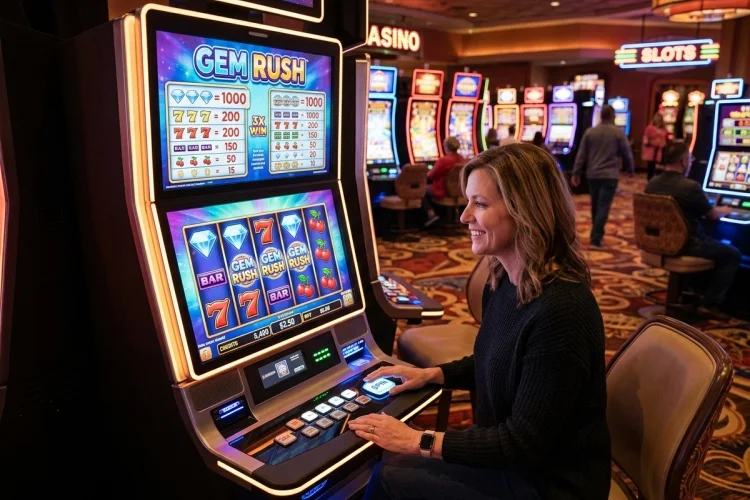
A slot machine is one of the easiest casino games to recognise. It usually has spinning reels, colourful symbols, a button or lever, and a paytable showing the available prizes.

Despite its simple appearance, plenty of technology and mathematics operate behind every spin. So, what is a slot machine, and how does it actually work?

In basic terms, it is a gambling game in which a player places a bet and receives a randomly determined combination of symbols. A prize is awarded when those symbols match one of the winning patterns listed in the game rules.

Modern versions may use physical reels, video screens, websites, or mobile apps, but they all follow this basic concept.

The Basic Purpose of a Slot Machine

A slot machine accepts a stake and produces a game result. Depending on the outcome, the player may receive no prize, a small return, a bonus feature, or a larger jackpot.

Unlike games such as poker or blackjack, standard slot results do not normally depend on a player’s strategic decisions. The main choices involve selecting the game, setting the stake, and deciding when to stop.

Gaming machines are also commonly called fruit machines, jackpot machines, or slots, although the exact terminology varies between countries.

Reels, Rows, and Symbols

Reels are the vertical columns containing symbols. Traditional machines generally use three physical reels, while video slots commonly display five or more virtual columns.

Rows run horizontally across the screen. A five-reel game with three rows displays 15 visible symbol positions.

Symbols can include numbers, fruit, playing-card icons, characters, or themed objects. Special symbols such as wilds, scatters, and bonus icons may substitute for other symbols or activate additional features.

How Paylines Create Winning Combinations

A payline is a pattern connecting symbol positions across the reels. It may run horizontally, diagonally, or in a zigzag shape.

For example, a game may require three matching symbols to appear from left to right on an active line. Matching symbols outside that pattern might not produce a prize.

Not every modern game uses traditional lines. Some offer hundreds of adjacent-reel combinations, while others pay for clusters of connected symbols. The game rules should clearly explain how wins are formed before a player places a wager.

What Happens When You Press Spin?

After the player selects a stake and presses spin, the game begins a new round. The system determines an outcome, displays the corresponding symbols, checks them against the paytable, and updates the balance.

On a mechanical machine, motors rotate and stop physical reels. Electronic machines can use a central processor to determine the result and direct reel motors to stop at the required positions.

In an online slot, the spinning reels are visual representations created by software. The animation displays the chosen result rather than physically generating it.

The Role of the Random Number Generator

Modern digital slots generally use a Random Number Generator, or RNG. This system continually generates numerical values that can be mapped to reel positions and game outcomes.

Regulatory standards require RNG-driven results to be statistically unpredictable. They also prohibit adaptive behaviour that changes outcomes simply to compensate for earlier wins or losses.

Each spin should therefore be treated as a separate event. A long losing sequence does not mean the next round must produce a prize.

How Payouts Are Calculated

The paytable lists each symbol’s value and the combinations needed to win. A payout may be shown as credits, a fixed amount, or a multiplier of the relevant stake.

Suppose three matching symbols award 15 times a $0.40 bet. The prize would be:

15 × $0.40 = $6

Always check whether the multiplier applies to the total stake, line bet, or coin value. These figures can produce very different results.

Understanding RTP and Volatility

Return to Player, usually shortened to RTP, is a theoretical percentage representing how much of the total money wagered may be returned as prizes over many rounds.

A 96% RTP does not promise that someone spending $100 will receive $96. The percentage is a long-term average, and an individual session may finish far above or below it.

Volatility describes how prizes may be distributed. Lower-volatility games generally offer smaller, more frequent returns, while higher-volatility games can produce longer gaps between prizes.

A slot machine is a chance-based game built around wagers, reels, symbols, and predefined payouts. Physical and digital versions may look different, but both generate a result and compare it with a paytable.

Modern slots commonly use RNG software to make each round unpredictable. Understanding reels, paylines, RTP, and volatility will not predict the next winning combination.

It simply helps players understand the rules and costs more clearly. Before playing, check local laws, read the paytable, confirm the total stake, and establish strict time and spending limits. Treat every slot as paid entertainment rather than a reliable source of income.