
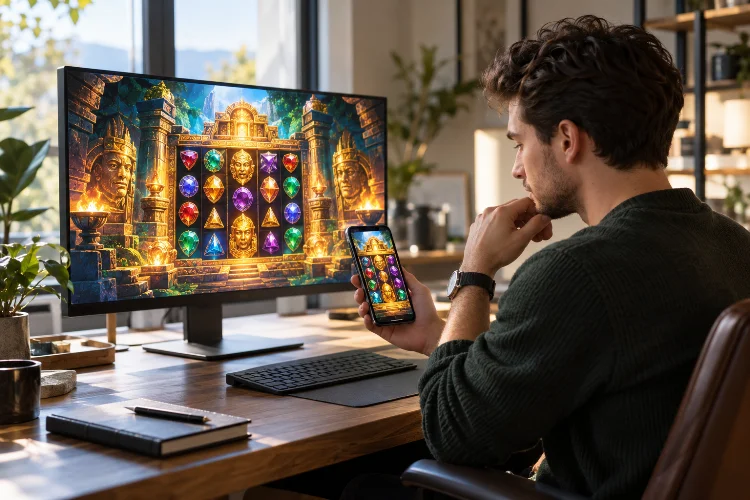
Choosing between mobile and desktop slots sounds simple until you play the same feature-heavy game on both. A phone gives you instant touchscreen access, while a desktop provides a much larger canvas and usually more processing headroom.
The question Are Slot Games Better on Mobile or Desktop? therefore depends on what you mean by “better.” Winning odds are one issue, performance is another, and convenience is something else entirely.
Once you separate those factors, the comparison becomes clearer. In many cases, the game design itself matters more than the device you use to open it.
Modern Slots Are Designed for Multiple Screen Sizes
Online slots are no longer built exclusively around desktop monitors.
Modern responsive design allows interfaces to change according to screen dimensions and resolution. Layouts can move buttons, resize game areas, and adapt information panels so the same web application remains usable across very different devices.
That is why many browser games no longer need completely separate “mobile editions.”
The underlying content can adapt dynamically.
Mobile-first development can even improve efficiency because phones can receive smaller visual assets suited to their displays instead of downloading oversized desktop imagery. MDN notes that responsive approaches can help avoid unnecessary performance costs from large images.
However, responsive does not mean identical.
A feature may move behind a menu on mobile simply because there is not enough space to display everything simultaneously.
Desktop Has More Hardware Headroom
A desktop PC usually has fewer physical constraints than a phone.
Larger cooling systems, higher sustained power limits, more RAM, and dedicated graphics hardware can provide extra performance for demanding web content.
This becomes relevant with modern slot games containing large grids, advanced animations, particle effects, and multiple bonus layers.
WebGL applications need to manage graphics memory and rendering resolution carefully across different hardware. MDN’s recommendations acknowledge that mobile and desktop systems can have different texture-compression capabilities and resource limits.
In practical terms, a powerful desktop can brute-force its way through heavier content more easily.
But do not assume every desktop wins.
A five-year-old low-spec laptop may perform worse than a recent flagship phone.
Device generation and optimization matter just as much as the basic category of “mobile” or “desktop.”
Mobile Can Be More Efficient With Well-Optimized Games
Phones have less hardware headroom, but developers know that.
A well-designed mobile experience can reduce image sizes, adjust rendering resolution, limit unnecessary effects, and reorganize content for smaller displays.
MDN points out that mobile hardware may struggle with dozens or hundreds of network requests, large images, and complex rendering, so reducing those workloads can improve performance substantially.
This creates an interesting situation.
A properly optimized game might launch extremely quickly on a modern phone because it loads only resources appropriate for that device.
Meanwhile, a desktop version could use higher-resolution graphics and larger assets.
This does not necessarily make one version objectively superior.
Desktop may deliver richer visuals, while mobile may provide a lighter and more efficient presentation.
For many players, the perceived difference is surprisingly small untill a demanding bonus sequence begins.
Larger Screens Make Game Information Easier to Read
Slot interfaces contain more information than the reels themselves.
You may need to read paylines, bet values, jackpot meters, free-spin counters, multiplier totals, feature rules, and game-history screens.
On desktop, those elements have more room.
A wide display can present several pieces of information without hiding the main game.
On mobile, responsive design often places less frequently used controls behind expandable menus.
That is not necessarily bad design. It prevents the screen from becoming cluttered.
But it does mean checking detailed paytable information can require more navigation.
MDN’s mobile guidance explains that narrow displays need different layouts and appropriate text sizing to remain usable.
If you regularly inspect rules and feature descriptions, desktop has a practical advantage.
If you mainly want a clean reel screen and a large spin button, the simplified mobile layout may actually feel better.
Touch Controls Make Some Features More Enjoyable
Mobile is particularly strong with interactive bonus rounds.
Picking treasure chests, revealing symbols, spinning bonus wheels, or selecting characters can feel natural when you touch objects directly.
Desktop interaction is more indirect because the mouse pointer sits between your hand and the interface.
However, mouse controls are precise.
Small buttons and detailed menus are easier to target without accidentally touching a neighbouring option.
The difference becomes especially clear when a mobile game has been poorly adapted from desktop. Tiny buttons may technically function on a touchscreen while still being frustrating to use.
Responsive web design aims to prevent exactly that kind of problem by adapting interfaces to different devices.
So touchscreen does not automatically beat mouse, and mouse does not automatically beat touchscreen.
Implementation decides the winner.
Connection Quality Can Matter More Than Device Type
A fast device cannot completely compensate for a weak network.
Online browser games need to download resources and communicate with remote infrastructure. Network requests, large files, and latency all contribute to how quickly content becomes available. MDN notes that many network requests can create noticeable delays, particularly on mobile connections.
Desktop computers often use stable home Wi-Fi or wired Ethernet.
Phones may move between Wi-Fi and cellular networks, potentially introducing changes in latency or bandwidth.
But the opposite scenario is equally possible.
A congested household Wi-Fi connection might perform worse than a strong mobile data network.
For that reason, “desktop is faster” is too simplistic.
If your game pauses mainly while loading or reconnecting rather than during animation, network conditions are worth checking before blaming the device.
Mobile and Desktop Should Not Change Randomness
Players sometimes wonder whether mobile versions have worse payouts because the games appear more compact.
Screen size should not be confused with game mathematics.
For random games, the UK Gambling Commission explains that results rely on statistical chance to meet theoretical RTP, while previous wins and losses do not affect the probability of the next random outcome.
If the same approved game configuration is delivered on desktop and mobile, simply switching devices should not change its designed RTP.
There is one important nuance.
Operators may offer different RTP configurations of some titles. Therefore, compare the game-information screen rather than assuming every casino serves exactly the same mathematical version.
That variation is about game configuration—not whether you tapped the spin button on an iPhone or clicked it with a desktop mouse.
Multitasking Is Easier on Desktop
Desktop has a practical advantage that has little to do with the slot itself.
You can keep the paytable open, manage multiple browser windows, adjust audio, view account information, or move between pages more comfortably.
Mobile operating systems are good at multitasking, but switching apps can sometimes cause resource-heavy browser tabs to reload, particularly if memory is limited.
A desktop with plenty of RAM is less likely to discard a browser session simply because you opened another application.
This matters most with complicated game research.
If you are comparing rules, RTP information, or bonus structures between several titles, the larger screen and traditional multitasking environment feel more efficent.
For straightforward play, though, mobile’s simplicity may be preferable.
You do not need several windows when everything you care about already fits into one responsive interface.
Battery and Portability Create the Biggest Trade-Off
Desktop systems can run demanding content without worrying much about battery percentage.
Phones cannot.
Continuous screen use, network activity, animation, and high brightness consume power. Long sessions can also generate heat, especially on graphically intensive games.
The trade-off is portability.
A desktop setup stays in one place, whereas a phone can be used wherever legal and appropriate access is available.
Neither benefit is objectively more important.
Someone playing short sessions may barely notice mobile battery consumption.
Someone spending longer periods exploring several complicated games may appreciate desktop power, cooling, and a bigger display.
This is why lifestyle often determines the better platform more than technical specifications do.
So Which Platform Actually Wins?
Mobile is strongest for convenience, portability, touchscreen interaction, and short sessions.
Desktop is stronger for screen space, sustained performance, multitasking, and detailed interfaces.
The quality gap is much smaller than it once was.
Responsive web technology allows modern games to adapt across devices, and powerful smartphones can handle experiences that previously required a computer.
A better question is therefore not “Which device always wins?”
Ask which one suits the specific slot.
A lightweight five-reel game may be more enjoyable on your phone. A giant multi-grid title with several bonus meters may make far more sense on a desktop monitor.
Test both when possible and judge the actual experience rather than the device label.
Are Slot Games Better on Mobile or Desktop? Neither platform wins every category. Desktop offers screen space, performance headroom, and easier multitasking, while mobile provides portability and intuitive touchscreen controls.
The same game should not become mathematically better simply because you change devices. Compare interface clarity, loading performance, connection quality, and comfort, then use whichever platform handles your preferred games best.