
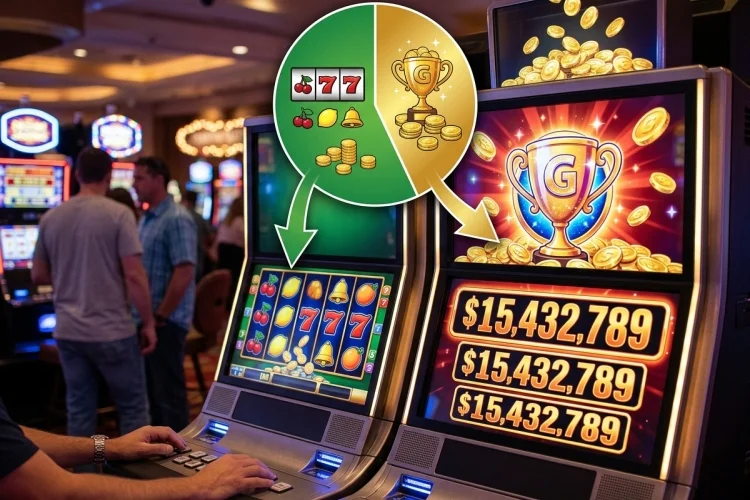
A progressive slot might display an RTP of 95% or 96%, yet ordinary gameplay can sometimes feel very different from a regular slot carrying the same percentage. The reason may be hidden in how the theoretical return is divided.
That leads to the question: Does a Progressive Jackpot Reduce Base Game RTP? In some progressive designs, a portion of the overall return is assigned to jackpot prizes, leaving a smaller percentage for regular gameplay.
But that is a design choice, not a universal rule. To compare games properly, you need to understand total RTP and its individual components.
RTP Is a Budget for Theoretical Payouts
A useful way to understand RTP is to think of it as a mathematical payout budget.
Imagine a slot designed with a theoretical 96% return.
That percentage could be distributed among several parts of the game: normal symbol wins, Free Spins, bonus features, fixed jackpots, and a progressive prize.
A non-progressive game might theoretically allocate the complete 96% across its regular features.
A progressive game could instead divide that expected return between ordinary gameplay and jackpot awards.
Regulators recognise this distinction. UK Gambling Commission standards state that progressive jackpot RTP may be presented either as one combined percentage or broken down into base-game and jackpot components.
So a single headline number does not necessarily describe regular reel play alone.
A Simple Progressive RTP Example
Consider a fictional progressive slot with the following mathematical allocation:
Base-game wins: 92.5%
Bonus features: 1.5%
Progressive jackpot: 2%
Combined theoretical RTP: 96%
Here, ordinary gameplay plus bonuses accounts for 94%, while 2% of the theoretical value comes through the jackpot mechanism.
Now compare that with a regular slot where the entire 96% is delivered through standard wins and features.
Both may technically carry the same overall RTP.
However, their payout distribution is not the same.
The progressive title concentrates part of its expected return into an infrequent high-value event. That difference can heavily influence the experience of short and medium sessions.
These figures are only an ilustrative example, not a universal jackpot formula.
Why Progressive Games Separate Jackpot Value
A progressive prize increases because qualifying play contributes to a jackpot system.
The Gambling Commission defines progressive jackpots as incremental prizes that grow from contributions associated with money staked in the game.
Modern systems can be local, linked across several games, or networked across multiple operators.
Pragmatic Play’s Power Jackpot, for example, uses four separate progressive tiers and states that fixed percentages from jackpot-game wagers feed those pools.
The actual accounting can include a seed amount, reserves, overflow pools, and reset values.
Because of those elements, you should avoid assuming that every dollar added visibly to a meter maps directly to an equal percentage of advertised RTP.
Base Game RTP Can Be Lower Without Changing Total RTP
This is the most important point.
Adding a progressive jackpot does not mathematically require the total RTP to fall.
A developer could reduce the base-game portion and redirect that theoretical value toward the jackpot while leaving total RTP unchanged.
Imagine Game A:
96% base-game RTP
No progressive jackpot
Now consider Game B:
93.5% base-game RTP
2.5% progressive component
96% combined RTP
Game B has the same total theoretical percentage but a lower base component.
In that scenario, the answer to the question is clearly yes: the progressive structure reduces the share returned through base play.
However, this does not prove that every progressive game follows that exact model.
Each certified game must be considered individually.
Why the Base Game May Feel “Tighter”
Large jackpots normally occur much less often than standard reel wins.
If part of a game’s RTP is concentrated inside a rare progressive event, most players will experience ordinary gameplay without ever seeing that portion returned directly to them.
This does not mean the RTP figure is fake.
It means RTP is calculated across the complete mathematical model and a huge number of wagers, including rare outcomes.
The UK Gambling Commission notes that progressive jackpots are sufficiently infrequent and large that their RTP performance can be difficult to evaluate using ordinary live monitoring. For that reason, it recommends monitoring the base game and progressive component separately.
That separation illustrates how different their payout behaviour can be.
Jackpot Contribution and RTP Contribution Are Different Ideas
Suppose a jackpot meter increases by a certain percentage of wagers.
It is tempting to say that percentage automatically equals the jackpot’s RTP contribution.
That shortcut can be misleading.
Part of the money may support the displayed progressive amount, while other portions may help reseed the jackpot after it is won or enter a reserve pool.
UK jackpot standards specifically require rules to explain funding, starting seed amounts, ceiling values, and how contributions are handled when limits apply.
Gaming Laboratories International also sets requirements for calculating progressive jackpot RTP and managing player-funded jackpot amounts.
For an accurate figure, use the game’s official theoretical RTP information rather than estimating from how quickly the meter moves.
Can the Growing Jackpot Change Expected Value?
Potentially, depending on the system.
If the probability of triggering a jackpot remains constant while the prize grows, the expected value of that jackpot event can rise with the meter.
The principle is easy to understand mathematically.
Suppose an event has a one-in-one-million probability. Increasing its prize from $500,000 to $1 million changes the expected return associated with that event, assuming everything else remains unchanged.
Progressive casino calculations often treat the current jackpot as a variable when determining theoretical return. Wizard of Odds, for example, separates fixed-award returns from jackpot-dependent returns in its progressive Casino Hold’em calculations.
However, slot systems can use very different rules.
Do not assume a progressive meter automatically makes a game positive expectation or dramatically improves its RTP.
Minimum Bets Can Also Matter
Some progressive systems require a specific qualifying wager before a player becomes eligible for the jackpot.
That condition matters when evaluating RTP.
GLI standards state that if a minimum bet is required for eligibility, the base game excluding the progressive jackpot must still meet the applicable minimum player-return requirements.
Modern online games can also handle eligibility in different ways.
Some jackpots are active at every stake, while others may require specific betting conditions.
Always read the jackpot rules before using the displayed prize as part of your comparison.
A huge progressive meter has no practical relevance if your selected wager is not eligble for it.
How to Compare Two Jackpot Slots Properly
Do not compare progressive games using jackpot size alone.
Start with the published total RTP and check whether it includes the progressive component. Next, find the base-game percentage if the developer publishes it separately.
Then examine volatility.
A game with substantial theoretical value tied to extremely rare jackpots may distribute returns differently from a game whose value is concentrated in more frequent regular wins.
You should also check the reset amount, jackpot structure, trigger conditions, qualifying stake, and whether the prize is local or networked.
Finally, confirm the exact game version.
Casinos and developers can sometimes offer different RTP configurations, so numbers from a review site may not always match the version actually loaded on your screen.
Higher Jackpot Does Not Mean It Is Due
A jackpot growing for weeks or months may look as though it must be close to paying.
For ordinary random progressives without a documented must-hit threshold, that conclusion does not follow.
Past unsuccessful spins do not by themselves make the next independent RNG result more likely to trigger the prize.
The current jackpot size can affect the monetary value of winning it, but this is seperate from saying that the win is “due.”
That distinction is important when thinking about progressive RTP.
RTP describes mathematical expected return over very large samples. It does not predict the timing of a jackpot or tell an individual player when to expect a major payout.
Does a Progressive Jackpot Reduce Base Game RTP? It can when part of the theoretical payout budget is redirected from regular gameplay into the progressive prize, although this varies by game.
Always distinguish base RTP, jackpot RTP, and combined RTP before making comparisons. Check the official paytable and jackpot rules rather than relying only on the headline percentage or jackpot amount.